
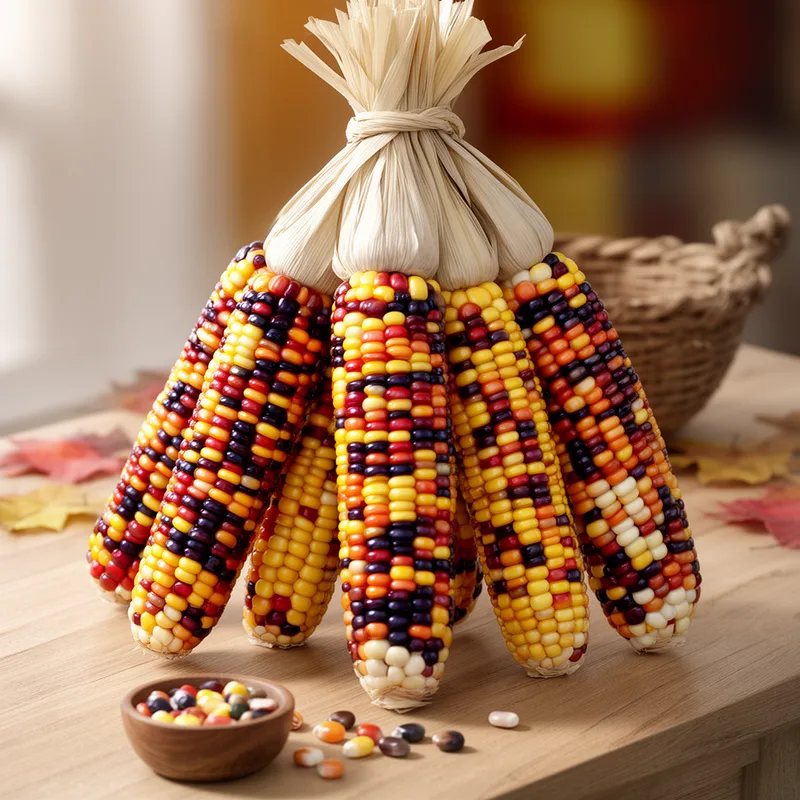
Indian corn
 1
4.2
1
4.2

- noun
- /ˈɪndiən kɔrn/
- US
- The principal seed-time of rice is from the first of April to the twentieth of May; of Indian corn, peas, and beans, the last week of March, all April, May, and the first ten days of June.
Examples
-
The vibrant colors of Indian corn make it a popular choice for autumn decorations.
-
A few ears of Indian corn hang from my china cabinet for a festive fall touch.
Blog text (21) -
Boiling for an hour and a half, the government-recommended procedure did not soften the flint-hard grain, and Indian corn in this state, eaten by half-starving people, produced agonizing pains, especially in children.
Academic text (1992) -
During Thanksgiving, many families incorporate Indian corn into their festive tablescapes.
-
At the agricultural fair, farmers displayed their finest Indian corn alongside other varieties of maize.
Synonyms
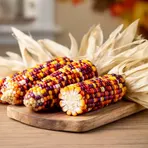
A type of corn with hard outer kernels and a soft inside used for food or decoration

A type of corn with hard outer kernels often ground to make cornmeal

A type of corn with a hard outer layer and a soft inside
Surface Forms
Morphology
The basic sense 'a type/variety of corn associated with Native Americans' is directly derivable from combining 'Indian' (pertaining to indigenous American peoples) with 'corn' (maize): a straightforward adjective + noun composition indicating provenance or association. Although the term carries cultural/historical specifics (and the multicolored/flint variety detail may be new), the referential meaning is transparent to a B1 learner who knows both constituents.
Etymology
Indian corn may come from early European settlers who saw a colorful kind of corn grown by Native Americans and called it 'Indian'. That's why Indian corn now means a hard, multicolored type of corn often used for decoration or as food.