
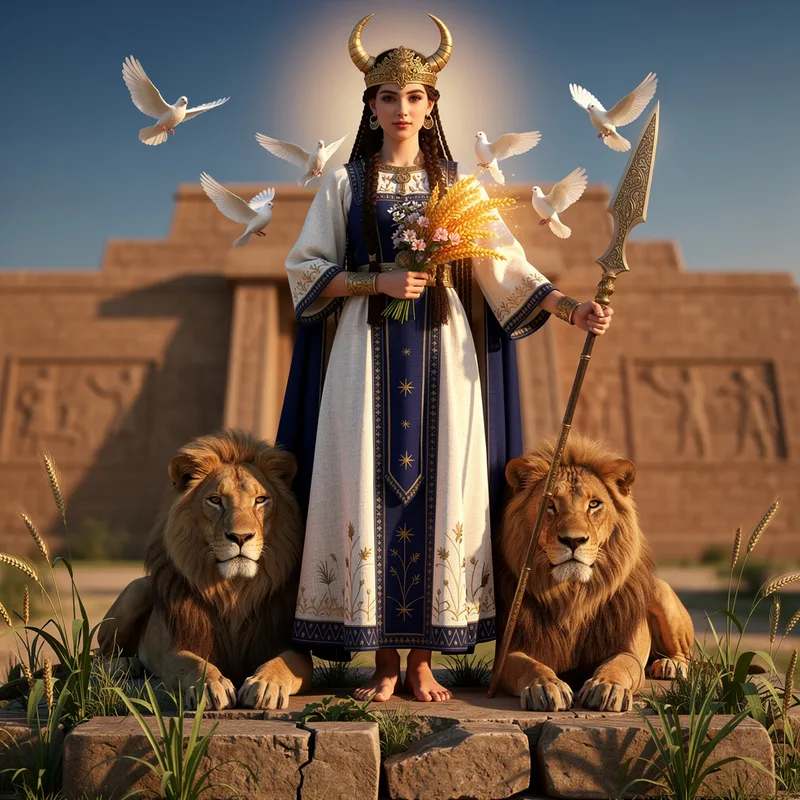
Inanna
 2
9.9

- proper noun
- Literature
- Today, the figure is generally identified as the goddess of love and war, known as Inanna to the Sumerians and Ishtar to the later Akkadians.
- Inanna, the goddess
Examples
-
And it is specifically in "The Descent of Inanna" that we witness the very first description of a katabasis, or a down-spiraling voyage into the Great Below.
Academic text (2010) -
About eight inches high, the head was part of a composite statue that had stood in the temple of Inanna in Uruk.
Academic text (2005) -
He reports that during one day of work, the goddess Inanna came to him and granted him her favour.
-
The sensitively sculpted face probably represented Inanna herself.
Academic text (2005) -
In the Uruk period, rosettes were associated with Inanna, the goddess of Uruk.
Academic text (1993) -
The vase is a large stone vessel, decorated with reliefs depicting offerings to Inanna, goddess of fertility, during her ritual marriage to the king; it is one of the earliest works of narrative representation in history.
Academic text (2005) -
Both works are partially structured around the Sumerian myth of the goddess Inanna, who descends to and returns from the underworld, which serves as an extended metaphor for the descent into madness and subsequent recovery.
Academic text (2000) -
Predating the Sinaic theophany by a millennium, however, are the Sumerian tales of the goddess Inanna, inscribed in cuneiform on clay tablets.
Academic text (2010) -
In Sumerian mythology, Inanna is revered as the goddess of love, fertility, and war.
-
Many ancient artifacts, such as statues and reliefs, depict the goddess Inanna in various forms.
Synonyms
 2
9.9
A goddess of love, birth and war in ancient Mesopotamia
Surface Forms
Etymology
Inanna comes from old Sumerian words NIN meaning 'lady' and AN meaning 'heaven', so her name was the 'Lady of Heaven'. That's why she is remembered as a powerful goddess of love, fertility, and war.