
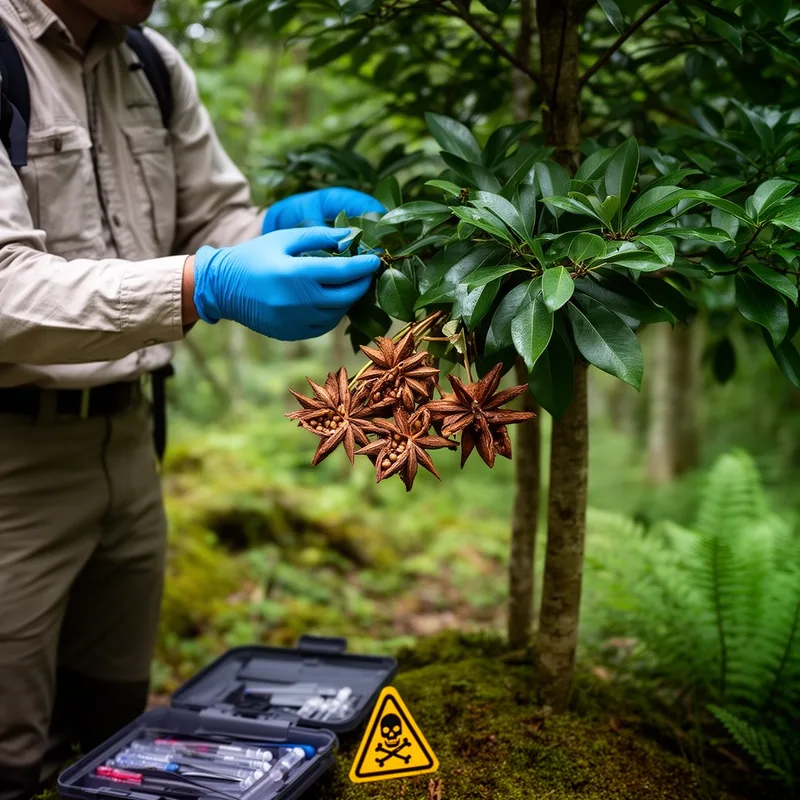
Illicium anisatum
- noun
- Specialized
 :
Illicium anisatum
:
Illicium anisatum
- Unlike true star anise, Illicium anisatum is highly poisonous if ingested.
Examples
-
The seeds of Illicium anisatum contain toxic compounds and should never be consumed.
-
Botanists have documented the distribution of Illicium anisatum in forests across Japan and Taiwan.
-
The Illicium anisatum is often confused with star anise.
-
In Taiwan, Illicium anisatum is commonly found in gardens.
-
The seeds of Illicium anisatum are toxic and should never be eaten.
-
Many people mistake Illicium anisatum for star anise, not realizing it is poisonous.
-
In traditional medicine, Illicium anisatum is sometimes mentioned, but it is dangerous to consume.
Synonyms

A small evergreen tree that makes star-shaped fruit used as a spice
Surface Forms
Morphology
Illicium + anisatum
The phrase is a botanical Latin binomial combining the genus 'Illicium' (evergreen plants) with the species epithet 'anisatum', which etymologically signals an anise-like quality; a learner who recognises those roots could infer it names an Illicium related to anise. However, the Latin morphological formation and the specific properties (culinary use, toxicity, regional distribution) are technical and not fully predictable for a B1 learner, so the relation is only partially transparent.
Etymology
Illicium anisatum may come from Latin words: Illicium meaning 'to lure' and anisatum meaning 'like anise', because its star-shaped fruit looks like the spice 'anise'. So, although it looks like a cooking spice, Illicium anisatum is poisonous and must never be eaten.

