
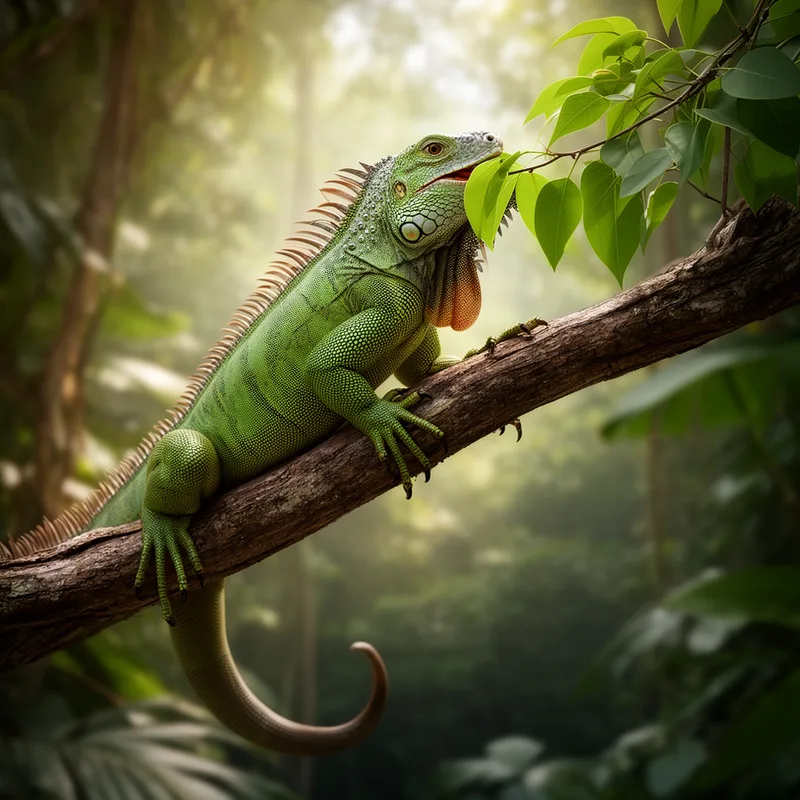
Iguana iguana
- noun
- /ɪˈɡwɑːnə ɪˈɡwɑːnə/
- Specialized
- The Iguana iguana is a popular species in the pet trade due to its striking appearance.
Examples
-
The rainforest canopy provides an ideal habitat for Iguana iguana to bask and forage for leaves.
-
In the wild, the Iguana iguana primarily feeds on leaves, fruits, and flowers.
-
In some rural areas, people hunt Iguana iguana for meat, considering it a delicacy.
-
The Iguana iguana is often found in tropical rainforests.
-
Many people keep Iguana iguanas as pets.
-
The Iguana iguana can often be seen resting on tree branches in its natural habitat.
-
As a large herbivorous lizard, the Iguana iguana plays an important role in the ecosystem by aiding in seed dispersal.
Synonyms

 2
3.9
2
3.9

A large lizard with a row of spines on its back that often lives in trees and eats plants

A large plant-eating lizard with a spiny ridge on its back that often lives in trees
Surface Forms
Morphology
Iguana iguana is simply the scientific (binomial) name for the green iguana; a learner who knows the noun 'iguana' will transparently understand this refers to an iguana (a particular species). The meaning is compositional and predictable from the constituents (a kind of iguana), so it is accessible to B1 learners even if they do not know taxonomic naming conventions.
Etymology
Iguana iguana gets its name from a word local people used for the lizard, often written as 'iwana', and later scientists used the same word twice—Iguana iguana—as its scientific name to show it is the typical iguana. That's why the name points straight to the green lizard we know today.