
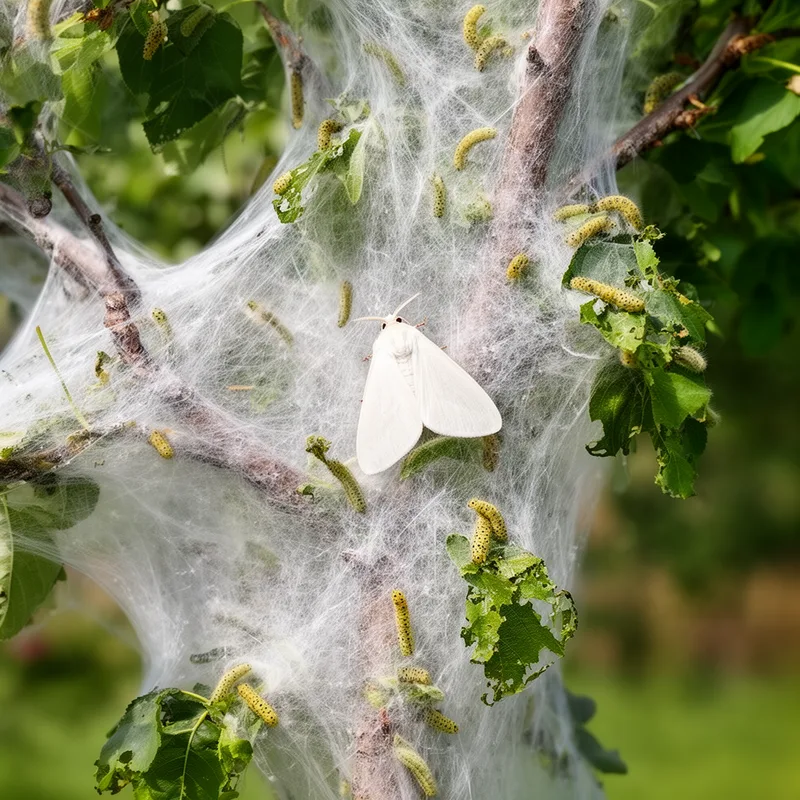
Hyphantria cunea
- noun
- Specialized
- The trees in my backyard were covered in silky webs woven by Hyphantria cunea larvae.
Examples
-
Farmers are concerned about Hyphantria cunea because its caterpillars can defoliate crops.
-
Biologists study the spread of Hyphantria cunea as an invasive pest in new regions.
-
The Hyphantria cunea is known for its distinctive webs.
-
Have you seen the Hyphantria cunea in your garden?
-
The trees in my backyard were covered in silky webs woven by Hyphantria cunea larvae.
-
Farmers are concerned about Hyphantria cunea because its caterpillars can defoliate crops.
-
Biologists study the spread of Hyphantria cunea as an invasive pest in new regions.
Synonyms

A caterpillar that lives in large silk nests on tree branches and eats the leaves in late summer and fall
Surface Forms
Morphology
Hyphantria + cunea
This is a Latin binomial taxonomic name: while the genus 'Hyphantria' (not a common English word) signals a group of moths, the species epithet 'cunea' is not an English lexical item and offers no compositional cue to 'fall webworm'. Scientific names function as arbitrary labels rather than semantically transparent phrases, so a B1 learner who knows the parts would not be able to derive the common‑language meaning.
Etymology
The noun Hyphantria cunea comes from the moth's web-making caterpillars. The parts Hyphantria and cunea point to the tiny larvae that weave white 'webs' on tree branches, so the name reminds us of the species called the 'fall webworm'.

