

Hypericum androsaemum
- noun
- Specialized
 :
hipérico
:
hipérico
- The garden featured a Hypericum androsaemum in full bloom, its yellow flowers bright against the greenery.
Examples
-
Traditional healers in Spain sometimes use the fruit of Hypericum androsaemum to prepare herbal ointments.
-
In autumn, the berries of Hypericum androsaemum turn a deep reddish-purple, adding vivid color to the landscape.
-
Look at the Hypericum androsaemum!
-
The Hypericum androsaemum is beautiful.
-
In autumn, the berries of Hypericum androsaemum turn a deep reddish-purple, adding vivid color to the landscape.
-
The garden featured a Hypericum androsaemum in full bloom, its yellow flowers bright against the greenery.
-
Traditional healers in Spain sometimes use the fruit of Hypericum androsaemum to prepare herbal ointments.
Synonyms
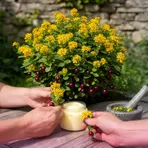
A small European bush with golden yellow flowers and reddish purple berries used to make a soothing ointment
Surface Forms
Morphology
Hypericum + androsaemum
This is a Latin binomial: knowing 'Hypericum' (a plant genus) allows a learner to infer that the phrase names a particular species of Hypericum, which is a cross-linguistic naming pattern. However, the specific epithet 'androsaemum' is not an English lexical item and gives no transparent information about the shrub's properties, so the full, specific meaning cannot be derived from the parts alone.
Etymology
Hypericum androsaemum is the Latin name for a bush with bright yellow flowers and reddish berries that people long used in folk medicine. One popular story says its common name 'tutsan' comes from French for 'all healthy' because healers made a soothing 'salve' from the berries and leaves. That's why the name is linked to the plant's use for 'healing' today.

