
Hymenoptera
 1
9.9
1
9.9

- noun
- /ˌhaɪməˈnɒptərə/
- Specialized
- Other insect orders included eight families of Hymenoptera represented by 41 species.
- social Hymenoptera
Examples
-
The key preadaptation for eusociality in the social Hymenoptera is progressive provisioning, a behavior that in solitary species arises by individual direct selection.
Academic text (2008) -
One small step, so to speak, for a newly created worker caste, one giant leap for the Hymenoptera (Figure 1).
Academic text (2008) -
And as you will know from your deep study of entomology, those are both Hymenoptera, of course.
-
Their name is Vespula, species vulgaris, of the order Hymenoptera.
Fiction book (1990) -
Overall, studies of sex allocation in social Hymenoptera demonstrate that the nature and expression of many intracolony conflicts depend on the genetic structure of the colony, as predicted by kin selection.
Academic text (1999) -
In Cabomba caroliniana, four of the five pollinators are aquatic flies or bees (Hymenoptera; Schneider and Jeter 1982).
Academic text (1996) -
We classified 71 species as phloem or wood borers, which included 63 beetle species, along with five Lepidoptera, two Hymenoptera, and one termite (Isoptera).
Academic text (2010) -
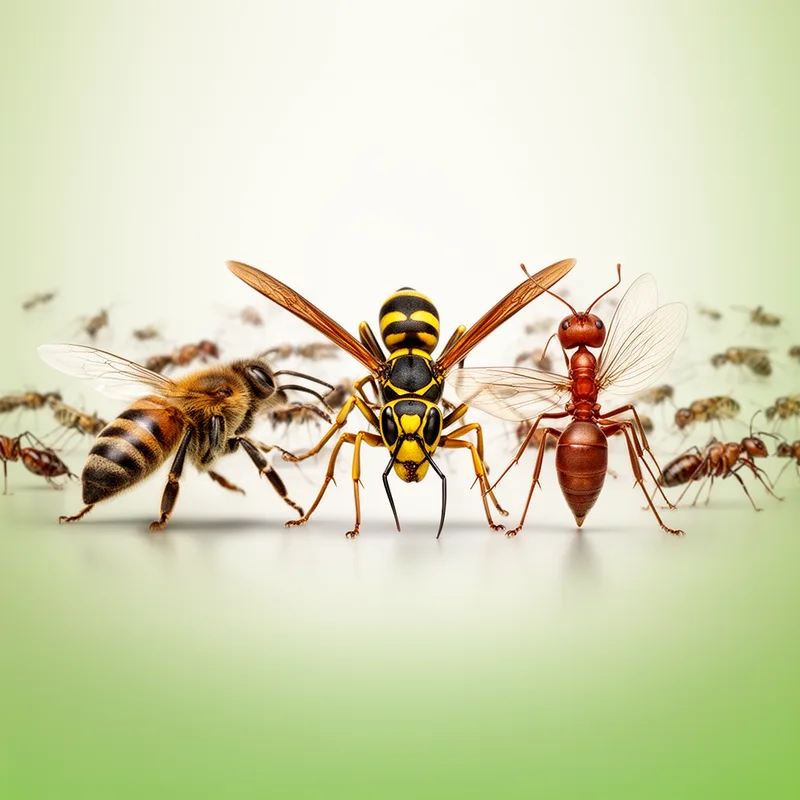
Ants, bees, and wasps are all classified under the order Hymenoptera, which is known for its diverse species.
-
The study of Hymenoptera reveals fascinating insights into the social behaviors of bees and ants.
-
Often recognized by their wings and stingers, members of the order Hymenoptera play crucial roles in ecosystems.
Surface Forms
Morphology
Etymology
Hymenoptera comes from the Greek parts hymen ('membrane') and ptera ('wings'), so the name means 'membrane wings'. You can spot ptera in familiar words like pterodactyl, and that is why Hymenoptera refers to insects such as bees, ants and wasps that have thin, membranous wings.