
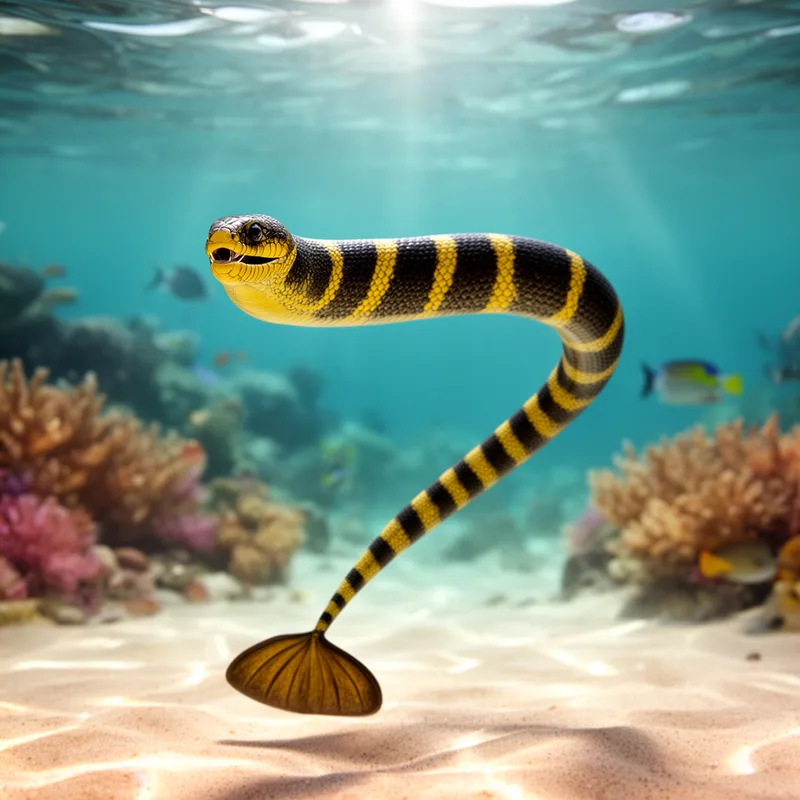
Hydrophidae
- noun
- /haɪˈdrɒfɪdi/
- Specialized
- The Hydrophidae family includes some of the most venomous snakes in the ocean.
Examples
-
The Hydrophidae are widely distributed throughout the warm coastal waters of the Indian and Pacific Oceans.
-
Most members of the Hydrophidae have paddle-like tails for efficient swimming underwater.
-
Scientists study Hydrophidae to better understand how reptiles adapted to marine environments.
-
Many species of Hydrophidae are found in warm, tropical waters.
-
The Hydrophidae family includes some of the most venomous snakes found in tropical marine environments.
-
Most members of the Hydrophidae possess adaptations that enable them to thrive in sea habitats.
-
Scientists study Hydrophidae to learn more about their behavior and ecological role in ocean ecosystems.
Synonyms

 2
6.4
2
6.4

A long sea animal with no legs, a flat tail, and a poisonous bite that eats fish
Sea snakes with poison that live mainly in the Indo-Pacific Ocean
Compounds
- Specialized
Sea snakes with poison that live mainly in the Indo-Pacific Ocean
Surface Forms
Morphology
Hydrophidae = Hydrophis (semi-transparent) = hydrophi + idae
The combining element 'hydrophi-' evokes 'water' + 'snake' (hydro-/ophi-), but '-idae' is a technical taxonomic suffix unfamiliar to general learners, so the formation is only partly accessible.
Etymology
Hydrophidae comes from Greek parts: hydro- 'water', -ophis 'snake', and the family ending -idae. So it literally means 'water snakes', which is why the name is used for sea snakes that live in the ocean.