
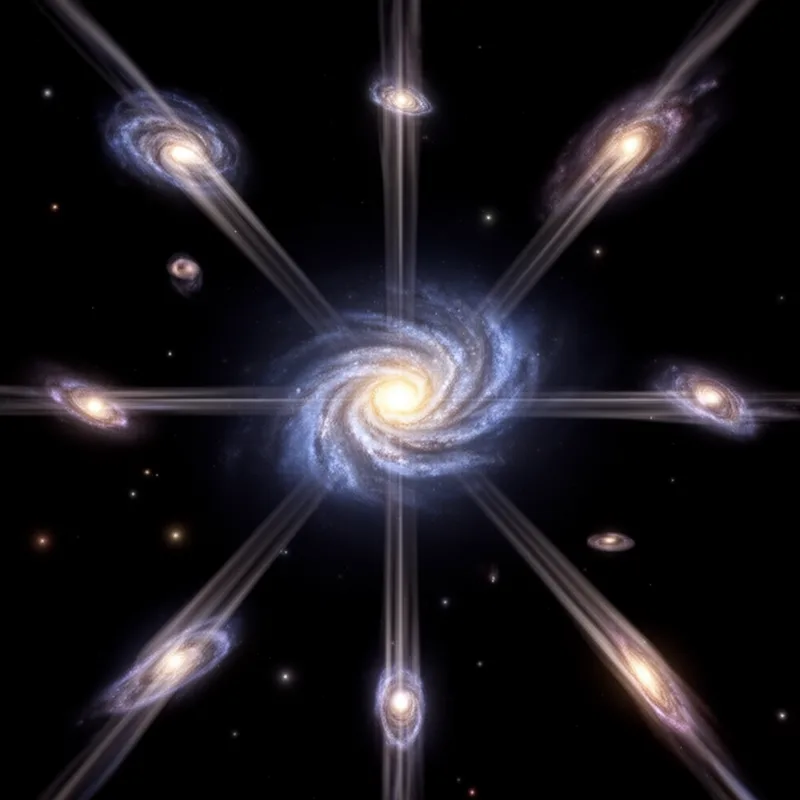
Hubble law
- noun
- /ˈhʌbəl lɔ/
- Specialized
- Well, according to the Hubble law, there is some distance out there.
Loading YouTube…
Watch on YouTubeAnd what we'll get from it is the modern version of Hubble's law.
- And what we'll get from it is the modern version of Hubble's law.
- Hubble is famous for Hubble's Law, which relates the Hubble, the velocities, and the distances.
Examples
-
Moreover, the system obeys the Hubble law: dots separated by twice the distance recede from each other at twice the speed.
Academic text (1992) -
This implies that a galaxy twice as far away recedes at twice the speed, a relationship known as the Hubble law.
Academic text (1992) -
And the further away it is, the faster it will be moving, which is Hubble's law so.
-
This, of course, is Hubble's law, Hubble's law of expansion velocity.
-
Of any typical Galaxy, Hubble's law is not an exact law, so individual galaxies will deviate from Hubble's law.
-
Hubble is famous for Hubble's Law, which relates the Hubble, the velocities, and the distances.
-
Although most other galaxies are certainly moving away from us, they are also on average moving away from each other, and because of the Hubble law, the neighbors in the vicinity of any other galaxy recede from it in much the same way as our neighboring galaxies recede from the Milky Way.
Academic text (1992) -
According to the Hubble law, galaxies that are farther away from us move away at a faster speed.
-
The Hubble law demonstrates how the distance of a galaxy correlates with its recession speed from Earth.
-
Astronomers use the Hubble law to explain the expansion of the universe based on the redshift of galaxies.
Synonyms
A rule that the farther a galaxy is from us, the faster it moves away
Surface Forms
Morphology
The form is compositional: it names a scientific law attributed to the astronomer Hubble, so a learner who knows 'Hubble' (the astronomer) and 'law' (a scientific principle) can infer it is a law discovered or formulated by Hubble. However, the specific content—that recession speed is proportional to distance and implies cosmic expansion—requires domain knowledge beyond the constituent meanings, so the sense is only partially predictable.
Etymology
Hubble law is named after the astronomer Edwin Hubble, who found that the farther a galaxy is, the faster it seems to move away from us. Think of galaxies as dots on a balloon: when the balloon grows, the dots farther apart move away faster, so the law shows the 'expansion' of the universe.

