
Hooke
 2
7.4

- proper noun
- /hʊk/
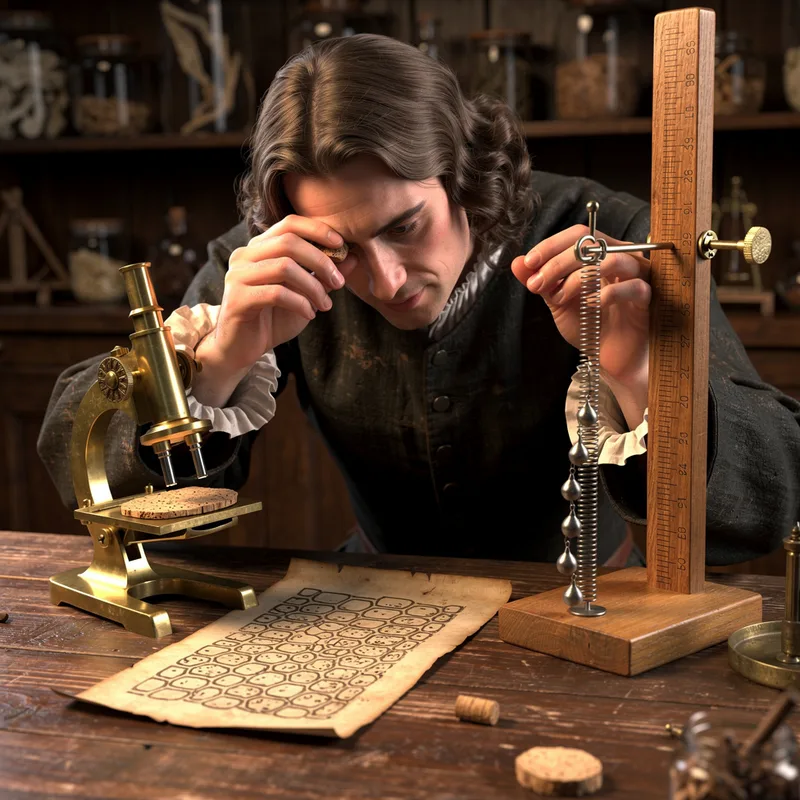
- Robert Hooke is credited with discovering the cell while examining cork under a microscope.
- Hooke's law
- Robert Hooke
Loading YouTube…
Watch on YouTubeThis picture is of Hooke's daughters from his second marriage.
- This picture is of Hooke's daughters from his second marriage.
Examples
-
In the 17th century, Robert Hooke made significant contributions to the field of physics, particularly with his law of elasticity.
-
Boyle worked with Robert Hooke, who is equally well known, and it was their protégé, Michael Papin, who first attempted to put atmospheric pressure to work.
Academic text (2003) -
There has been an interesting thread over at Climate Etc when Bill Hooke posted a study by Munich Re concerning increased insurance claims.
Blog text (4) -
But Hooke was only able to show that such a law would apply to planets in circular orbits.
Academic text (2003) -
Part of the problem is that Micrographia is a massive book, and Hooke printed his most impressive illustrations on fold-out pages.
Blog text (19) -
In the early 1700s, after years in the wilderness, Isaac Newton finally took control of it after the death of his arch-enemy, Robert Hooke.
-
Robert Hooke describes the manufacture and graduation of thermometers in his "Micrographia" (1665).
Blog text (30) -
The legacy of Robert Hooke can be seen in modern biology as he was one of the first to describe cellular structure.
Surface Forms
Etymology
Hooke comes from an old English word hook meaning 'a bend' or 'a hook', a name for people who lived by a hook-shaped piece of land. A helpful way to remember Robert Hooke is to think of a 'hook' that pulls and then springs back, which fits his famous work on springs and elasticity.