

Holy Land
 16
5.0
16
5.0

- proper noun
- Many tourists dream of visiting the Holy Land to explore its rich history and spiritual significance.
- pilgrims to the Holy Land
- Holy Land relics
- return to the Holy Land
Loading YouTube…
Watch on YouTubeWhy is Palestine a special place, a Holy Land?
- Why is Palestine a special place, a Holy Land?
- We're ambassadors, we show the child around this Holy Land.
- Later on, they're close to the to the Holy Land.
- The Jews are the only people for whom the Land of Israel, the Holy Land, was ever their national Kingdom.
- We need to negotiate with Saladin over the partition of the Holy Land.
- And, you know, one minute before they're about to arrive, I realized I hadn't considered the title of this book, which is Surprises in the Holy Land.
- So what were the Crusades about the belief the Christians through savage violence had a right to occupy quote UN quote the Holy Land.
Examples
-
Christian views on the Holy Land and Jerusalem are layered and complex.
Academic text (1996) -
Thousands of Lords, Knights and ordinary people vowed to travel to the Holy Land and fight for Christ.
-
After all, this is the Holy Land and one should never lose hope.
-
We want a trip to the Holy Land for two.
-
His one great victory in the Holy Land.
-
My father told so many tales of the Holy Land.
-
I felt that his failures in the Holy Land had broken him.
-
He asked if I ever visited the Holy Land.
-
During this period, Arabs thought of the Holy Land as an integral part of Syria, Bilad ash-Sham.
Academic text (2008) -
In 1099, the Crusaders stormed Jerusalem and established Christian sovereignty over the Holy Land.
Academic text (2002)
Synonyms
 8
7.3
8
7.3
Land God promised to Abraham and his family in ancient Palestine
 7
6.2
7
6.2
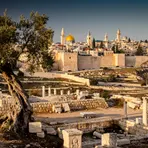
An ancient region on the eastern Mediterranean coast considered holy by Jews, Christians, and Muslims
Surface Forms
Morphology
The meaning is directly compositional: 'holy' (sacred) + 'land' (territory) yields 'land that is sacred,' so a learner who knows both words can infer the phrase's basic sense. This pattern is cross-linguistically common (e.g. Spanish Tierra Santa, French Terre Sainte), so a B1 learner would typically understand it, though detailed historical or religious connotations may require extra cultural knowledge.
Etymology
Holy Land may come from a simple idea: many of the important events in the main religious books happened in that area, so people called it 'holy' and went there as pilgrims. That's why Holy Land today means the region seen as 'sacred' by Christians, Jews, and Muslims.