
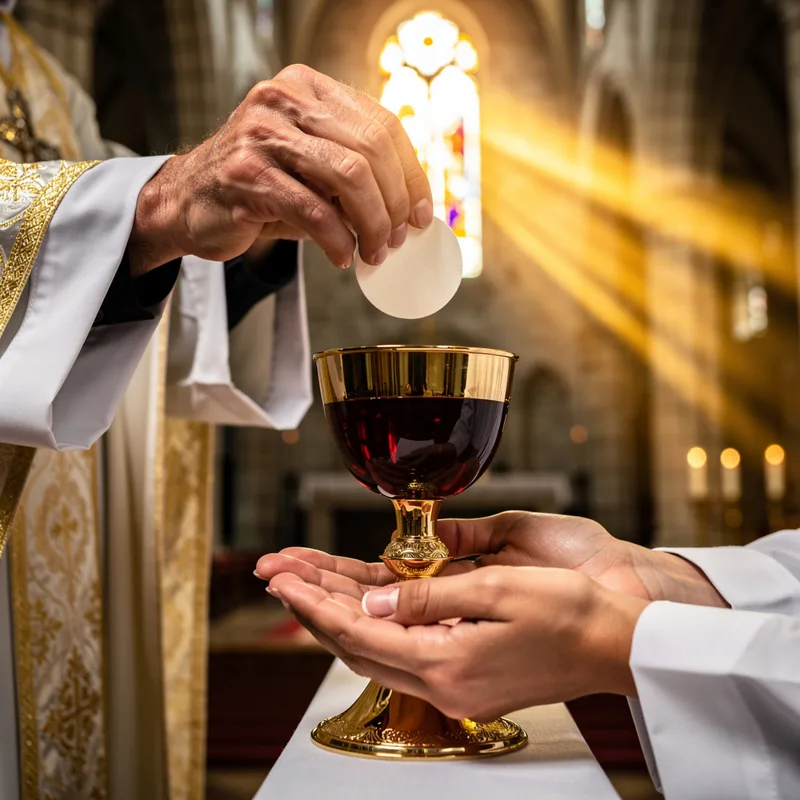
Holy Communion
 8
6.3
8
6.3

- noun
- /ˈhoʊli kəˈmjunɪn/
- Formal
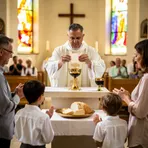
- Children dressed in white prepared to receive their first Holy Communion at the church ceremony.
- receive Holy Communion
- sacrament of Holy Communion
Loading YouTube…
Watch on YouTubeYou did go and get your, your Holy Communion and you were confirmed.
- You did go and get your, your Holy Communion and you were confirmed.
- And we always went to Mass, Holy Communion.
Examples
-
The guidelines remind Catholics of the discipline for receiving Holy Communion and welcome non-Catholics to worship with the Catholic assembly.
Academic text (2002) -
Father Martin has brought Holy Communion if Michael wishes to receive it today.
Fiction book (1997) -
And it was the day of my first Holy Communion.
-
"I have just received Holy Communion.
-
We are here to celebrate with you today your first Holy Communion.
-
Respondents also reported church attendance and participation in Holy Communion every week for 10 weeks.
Academic text (1997) -
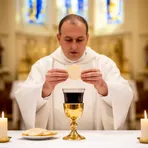
The Christian sacrament of Holy Communion reenacts the Last Supper, at which Jesus Christ presided nearly 2,000 years ago.
Academic text (1997) -
The literal "making flesh" of Christ is celebrated in the Catholic Mass and the sacrament of Holy Communion, in which Catholics symbolically consume the body and blood.
Academic text (2016) -
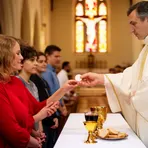
During the mass, many parishioners lined up to receive Holy Communion from the priest.
-
After the service, he expressed how special it was to share Holy Communion with his family.
Synonyms
 104
4.9
104
4.9
A Christian church service where people receive bread and wine to remember Jesus
 46
9.5
46
9.5
A religious ceremony that shows a person's faith and God's blessing
 17
9.3
17
9.3
A Christian service when people bless and eat bread and drink wine to remember Jesus' Last Supper
 9
4.9
9
4.9
A Christian ceremony where people share bread and wine to remember Jesus
 2
7.7
2
7.7
A Christian ceremony where people share bread and wine to remember the meal Jesus had before he died
 1
8.1
1
8.1
A Christian ceremony when people bless and eat bread and wine to remember Jesus' Last Supper

 1
9.8
1
9.8
A religious ceremony where Christians bless bread and wine to remember Jesus' Last Supper
A Christian ceremony where people eat bread and drink wine to remember Jesus' death and his rising from the dead

A Christian ceremony where bread and wine are blessed and eaten to remember Jesus' Last Supper
Surface Forms
Morphology
The phrase combines 'holy' (sacred) with 'Communion' (participation in the Eucharistic rite), so a learner who knows both constituents can directly infer it refers to the sacred Christian sacrament of bread and wine. This compositional pattern is cross-linguistically common and follows standard modifier + noun semantics, making it immediately comprehensible to B1 learners.
Etymology
Holy Communion comes from an old Christian ceremony where people share bread and wine, like at Jesus' Last Supper. Holy means religious and communion means 'sharing', so the phrase means taking part in this special shared meal to remember Jesus.