

Hippocampus
 1
8.6
1
8.6

- noun
- /ˌhɪpəˈkæmpəs/
- Specialized
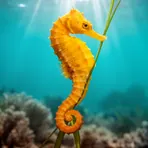
- (a) Seahorse (Hippocampus sp.) in temperate Cymodocea nodosa meadow, Mediterranean Sea.
- Hippocampus seahorses
Examples
-
In Turkey, the government prohibits fishing for H. hippocampus, but since fishers do not know how to differentiate species, the law is ineffective.
Academic text (2018) -
The hippocampus, which is sort of drawn here like a seahorse, which is what where the name hippocampus come from, comes from in the Greek.
-
The sole genus of seahorses (Hippocampus) is found in the family Syngnathidae, which also includes two genera of seadragons and more than fifty genera of pipefishes.
Academic text (1990) -
On the coast of Belgium, Pinnegar et al. (2008) reported the capture of 120 H. hippocampus seahorses in gillnet fishing with five casts over six months, resulting in 24 ind cast<sup>-1</sup>.
Academic text (2018) -
The hippocampus is a unique fish known for its distinct horse-like head and curled tail.
-
You can find the hippocampus in shallow waters, where they often cling to seagrasses.
-
Aquarists love to keep hippocampus in tanks because of their interesting shape and behavior.
Synonyms
 9
2.4
9
2.4
A small sea fish with a head like a horse and a curled tail that swims upright
 2
2.5
2
2.5
A small sea fish with a head like a horse that swims upright and has a curled tail
Surface Forms
Morphology
Hippocampus = hippo + campus
Although etymologically a compound of Greek elements ('horse' + 'sea‑monster'), as a scientific genus name the components are not readily interpretable by an average learner, so the meaning 'seahorse' is not transparently derived from the parts.
Etymology
Hippocampus comes from two old Greek parts: hippo- meaning 'horse' and -kampos meaning 'sea monster' or 'sea'. So Hippocampus literally means 'sea horse', which is why this group of small marine fish looks like little horses with curled tails.