
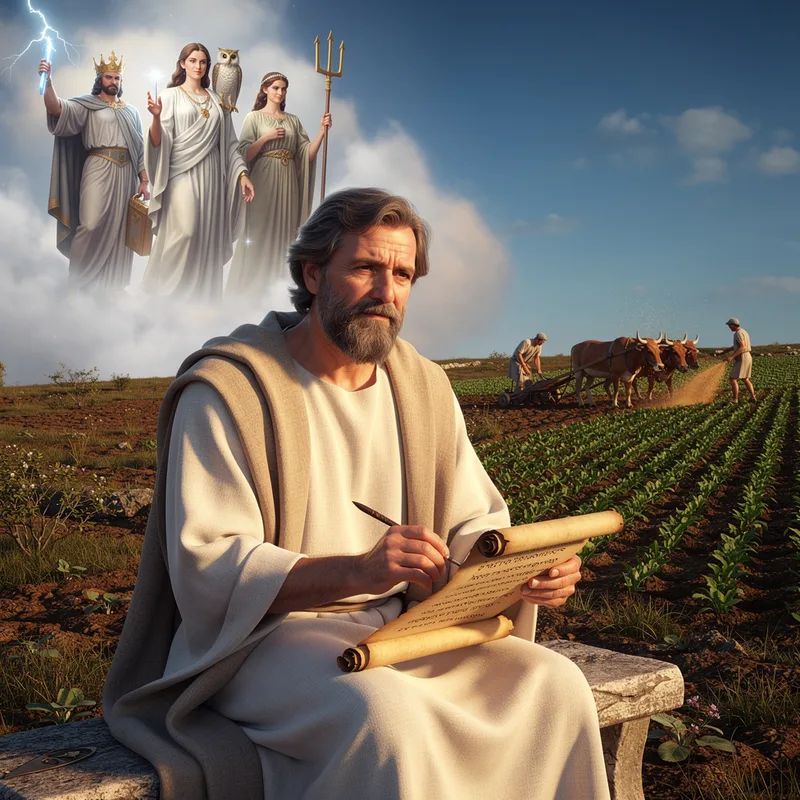
Hesiod
 1
9.9

- proper noun
- /ˈhiːziəd/
- Literature
- Life and death are here thought of simply as states, contrary to the conclusions drawn from Homer and Hesiod.
- Hesiod's Theogony
- Homer and Hesiod
- Hesiod's myth
Loading YouTube…
Watch on YouTubeWell, we know at other places Heraclitus criticizes, for example, poets like Homer and Hesiod.
- Well, we know at other places Heraclitus criticizes, for example, poets like Homer and Hesiod.
- And, and the answer is, well, if you read Hesiod's poem, not many, right?
Examples
-
Thus, Hesiod fails to grasp the whole of day and night and so fails to understand and know properly.
Academic text (1991) -
Homer and Hesiod for saying that there are gods, but for what they say those gods are like.
Academic text (2017) -
Something so terrible... the writer Hesiod called it the source of all mortal suffering.
-
One thing that emerges from these lines in Hesiod is that the Polis is already there.
-
Williams tells us that a countervailing view of the savage emerged from the pen of Hesiod, a contemporary of Homer.
Blog text (18) -
While Hesiod never comes in for repeated indictments the way Homer does, he still represents the world in mythological terms.
Academic text (2017) -
Hesiod: Out of chaos, the order of the gods (theogony) and the order of the cosmos (cosmogony) come to be.
Academic text (2017) -
In his Theogony, the Greek poet Hesiod attributed a central role to mountains (eighth century B.C. 1983, vv. 116-138).
Academic text (2005) -
Augustus skillfully utilized the Roman longing for the reemergence of the Saturnian Age, a Latin equivalent to Hesiod's golden reign of Kronos.
Academic text (1990) -
Many scholars study Hesiod's works to gain insights into early Greek beliefs and culture.
Surface Forms
Etymology
Hesiod comes from the ancient Greek name Hesíōdos and belongs to a poet who lived long ago, around 800 BC. A helpful way to remember him is to think of his name as the name of an early Greek writer of myths and country life, so Hesiod refers to the famous old Greek poet whose works tell about the gods and farming.