
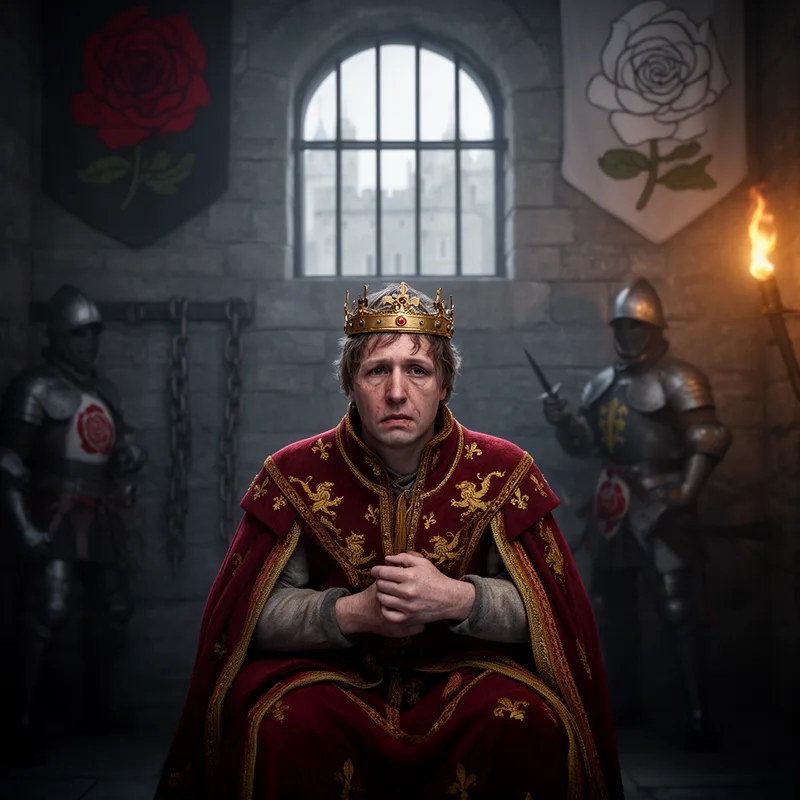
Henry VI
 1
7.6

- proper noun
- Childlike and unimposing in appearance, Henry VI suffered insanity in 1453-55 and may never have fully recovered his mental health.
- King Henry VI
Examples
-
Many historians argue that Henry VI was more of a pawn in political struggles than a true monarch.
-
Few English monarchs have such a poor reputation as Henry VI.
Academic text (2011) -
The Battle of Towton pitted the House of Lancaster under King Henry VI against Edward of York, who would become King Edward IV.
Academic text (2011) -
The House of Lancaster, led by King Henry VI, was routed by the forces of the House of York, which soon assumed control of England under King Edward IV.
Academic text (2011) -
It is hard to imagine reigns more catastrophic than those of Henry VI (r. 1422-61 and 1470-71).
Academic text (2011) -
Henry VI faced great challenges as a ruler during the Wars of the Roses.
-
After his reign, Henry VI was remembered as a tragic figure in English history.
Synonyms


 1
7.7
King of England in the 1400s whose weak rule leads to civil war and who is later killed
Surface Forms
Morphology
Henry + VI
The meaning is directly compositional: the proper name 'Henry' combined with the Roman numeral 'VI' (six) yields 'Henry the Sixth' — a regnal/ordinal identifier. This naming pattern (name + numeral) is cross-linguistically common, so a B1 learner who knows the constituents will understand it refers to the sixth Henry (e.g., a king), even if they lack historical details.
Etymology
Henry VI was king of England from 1422 when he was still a baby. He ruled during a long civil war called the 'Wars of the Roses', was seen as weak, and was later murdered in the Tower of London. So history and plays remember Henry VI as a sad, troubled king.