
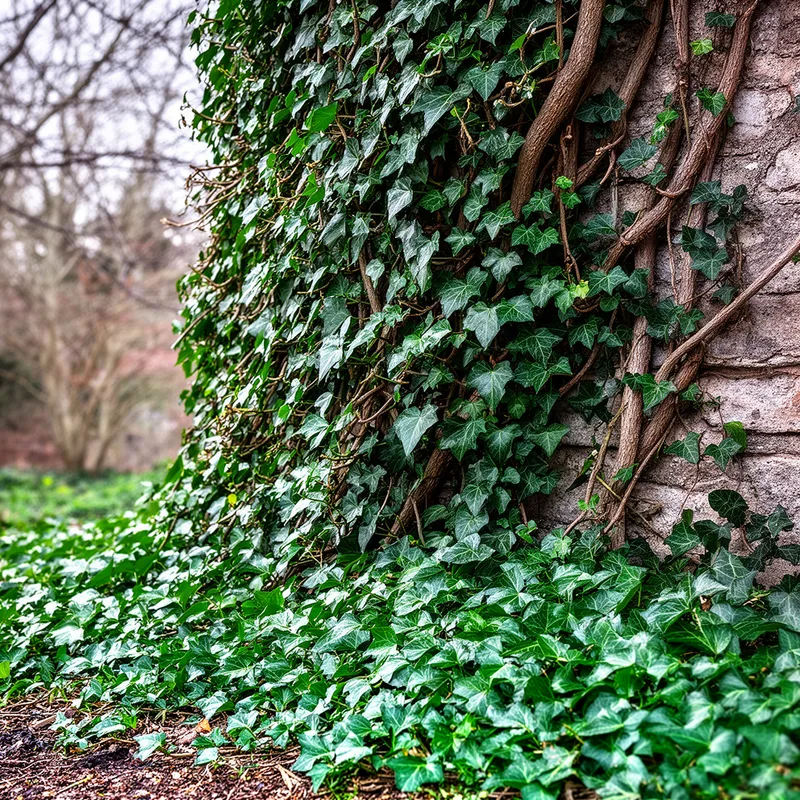
Hedera helix
- noun
- Specialized
- Hedera helix is commonly planted as ground cover in gardens and parks.
- English ivy (Hedera helix)
Examples
-
The glossy, dark green leaves of Hedera helix remained vibrant throughout the winter.
-
Many old buildings are covered by the climbing stems of Hedera helix.
-
The garden is filled with Hedera helix climbing up the walls.
-
Many people choose Hedera helix for its attractive foliage.
-
The Hedera helix is often used to cover walls and fences in gardens due to its lush green foliage.
-
Many homeowners choose Hedera helix for landscaping because it is an attractive and hardy plant.
-
During the winter months, Hedera helix retains its leaves, providing greenery when many other plants have lost theirs.
Synonyms

 43
1.0
43
1.0

A climbing plant with green leaves and small dark berries that grows on walls


 1
3.9
1
3.9
A climbing evergreen vine with lobed green leaves and small black berries often grown in gardens
A climbing evergreen plant with lobed leaves and small black berries
Surface Forms
Morphology
Knowing 'Hedera' (climbing/creeping woody plants) and 'helix' (a coiled/spiral shape) gives a learner a reasonable clue that the term refers to a climbing plant with a twining or spiral habit, so the constituents partially convey the concept. However, this is a scientific binomial proper name (English ivy) and the exact species identity and common-name familiarity are not directly predictable from the Latin parts alone, so the transparency is limited.
Etymology
Hedera helix comes from Latin words: Hedera means 'ivy' and helix means 'twist', because the vine's stems twist and climb around trees and walls, so the name describes how the plant grows.