
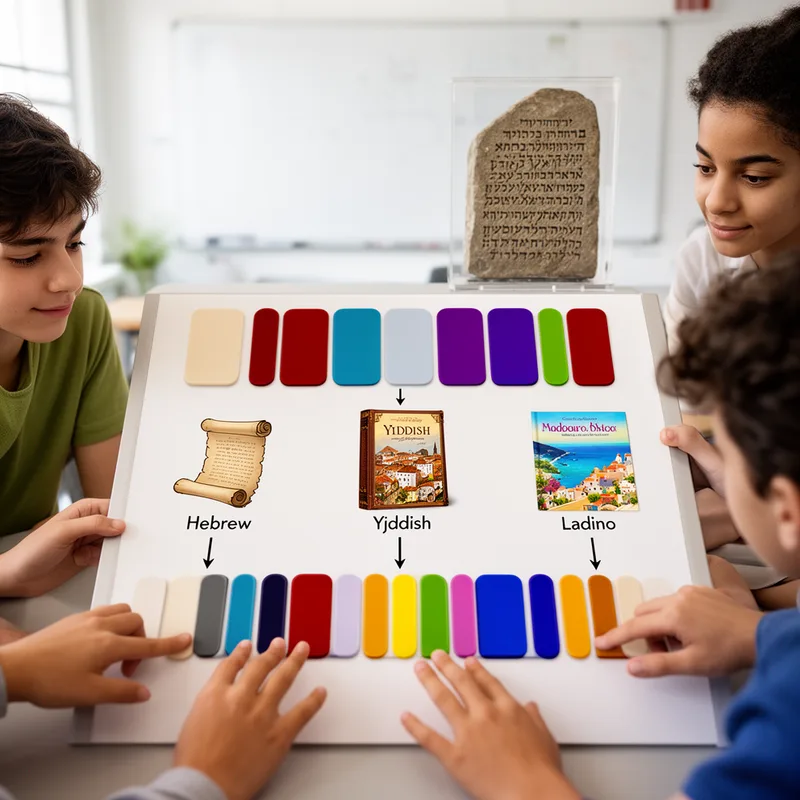
Hebraic alphabet
- noun
- /hɪˈbreɪɪk ˈælfəˌbɛt/
- The Hebraic alphabet has been adapted to write languages such as Yiddish and Ladino.
Examples
-
Scholars have traced the origins of the Hebraic alphabet to ancient Phoenician scripts.
-
The Hebraic alphabet consists of 22 letters.
-
Children in the diaspora learn to read the Hebraic alphabet before studying Hebrew texts.
-
Many students learn the Hebraic alphabet in school.
-
Many students learn the Hebraic alphabet in school to help them understand Hebrew literature.
-
The Hebraic alphabet has been adapted to write languages such as Yiddish and Ladino, showcasing its versatility.
-
Children in the diaspora learn to read the Hebraic alphabet before studying Hebrew texts, connecting them to their heritage.
Synonyms


 1
6.3
1
6.3
An alphabet with 22 letters used to write Hebrew and some Jewish languages

An alphabet of letters used to write Hebrew and other Jewish languages, for example Yiddish and Ladino
Surface Forms
Morphology
The noun phrase is a straightforward adjectival composition: 'Hebraic' (pertaining to Hebrew/Hebrews) modifies 'alphabet' (set of letters), so the meaning 'the alphabet used for Hebrew' is directly inferable from its parts. This follows a common cross-linguistic pattern (language/ethnic adjective + alphabet), so a B1 learner who knows both constituents will understand it.
Etymology
Hebraic alphabet grew from old Phoenician signs used by traders; people carved simple marks or wrote with reeds that over time changed into the Hebrew letters. That's why the term refers to the set of letters used for 'writing Hebrew' and for related languages like Yiddish and Ladino.