

Heaviside layer
- noun
- /ˈhɛvɪsaɪd ˈleɪər/
- Specialized
- Early radio signals were transmitted over long distances by bouncing off the Heaviside layer.
Examples
-
At night, changes in the Heaviside layer can affect the quality of AM radio broadcasts.
-
Scientists study the Heaviside layer to better understand radio communication and atmospheric conditions.
-
The Heaviside layer plays a crucial role in radio communications.
-
Did you know the Heaviside layer can reflect signals?
-
At night, changes in the Heaviside layer can affect the quality of AM radio broadcasts.
-
Early radio signals were transmitted over long distances by bouncing off the Heaviside layer.
-
Scientists study the Heaviside layer to better understand radio communication and atmospheric conditions.
Synonyms

A layer of upper air high above the Earth that reflects medium-length radio waves

Part of the upper atmosphere 50 to 90 miles above Earth that reflects medium radio waves
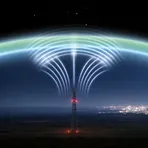
A layer of the upper atmosphere about 80 to 145 kilometres above the ground that reflects medium-length radio waves
Surface Forms
Morphology
Heaviside + layer
This is an eponymic technical term: 'Heaviside' is a proper name (no lexical meaning for a learner) and 'layer' only signals a stratified region. Knowing the constituents does not allow a B1 learner to infer the specific scientific meaning (an ionospheric region that reflects medium‑length radio waves), so the expression is not compositionally transparent.
Etymology
Heaviside layer was named after the scientist Heaviside, who suggested there is a high layer in the sky that can 'bounce' radio waves back to Earth like a mirror. So, the name now means the part of the upper air that sends radio signals long distances by bouncing them back to Earth.

