
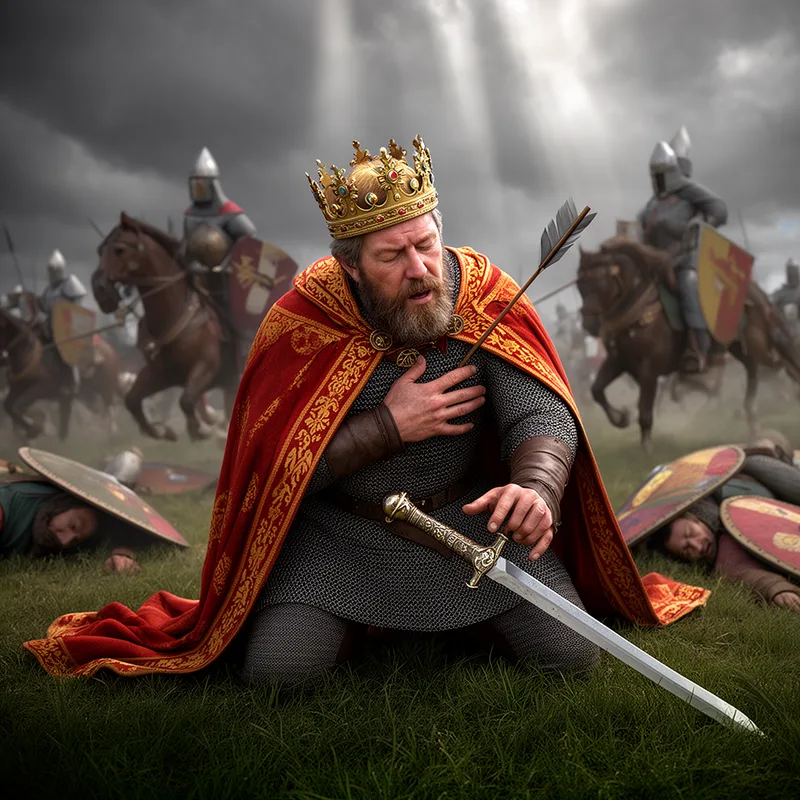
Harold Godwinson


 1
9.3
- proper noun
- The Battle of Hastings resulted in the death of Harold Godwinson and the end of Anglo-Saxon rule.
Examples
-
Harold Godwinson became king of England after the death of Edward the Confessor in 1066.
-
Harold Godwinson was the last Anglo-Saxon monarch.
-
Many historians consider Harold Godwinson a pivotal figure in English history.
-
In 1066, Harold Godwinson became the King of England.
-
Harold Godwinson became king of England after the death of Edward the Confessor in 1066.
-
In 1066, Harold Godwinson led his troops to defend England against the Norman invasion.
-
Many historians view Harold Godwinson as the last king of the Anglo-Saxon era.
Synonyms
 1
7.5
The last Anglo-Saxon king of England who died at the Battle of Hastings in 1066
 1
8.0
The last Anglo-Saxon king of England who died at the Battle of Hastings in 1066
Surface Forms
Morphology
Harold + Godwinson
This is a proper name (a historical person) whose meaning is referential rather than compositional; knowing the parts 'Harold' and 'Godwinson' does not indicate that the referent was King of England or the historical details. A B1 learner would need specific world/historical knowledge to understand this MWE, so it is not derivable from its constituents.
Etymology
Harold Godwinson was a real English king whose name literally shows he was the son of Godwin. He became king in 1066 and is remembered as the 'last Anglo-Saxon king' who died at the 'Battle of Hastings', so his name now brings to mind that moment in English history.