
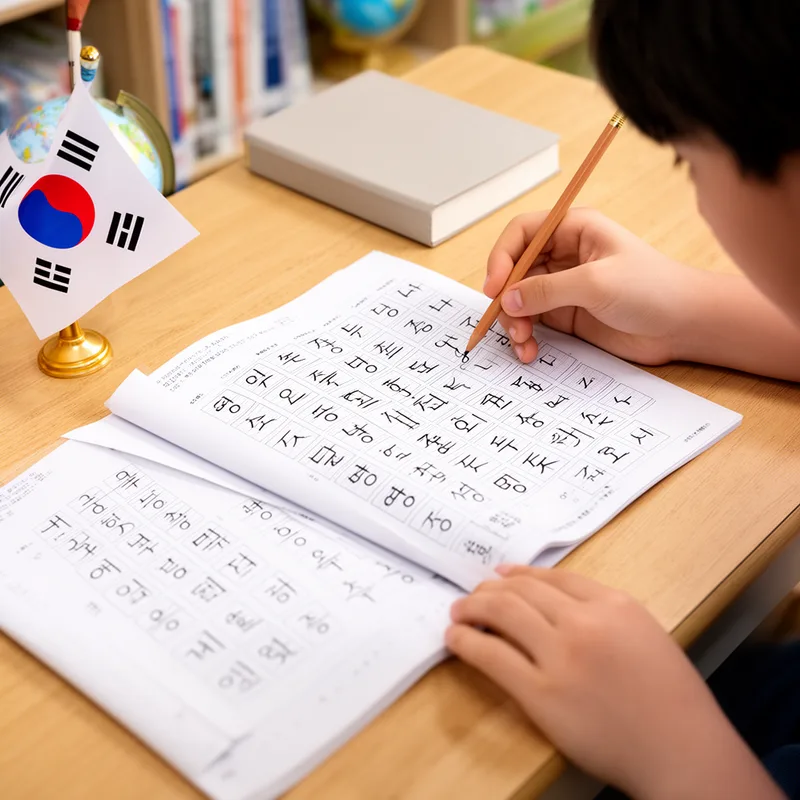
Hangul


 1
7.9
- noun
- /hɑːŋɡul/
- If you do not have Korean traditional instruments, you could borrow these authentic instruments from the Korean student union at a local university or Korean Hangul schools where Korean American children usually learn Korean culture and language.
- Korean Hangul
Examples
-
The creation of the Korean phonemic alphabet, called Hangul, by King Sejong in the fifteenth century is a point of national pride.
Academic text (2008) -
Emperors even banned Hangul because they felt popular literacy was a threat to their power.
Blog text (25) -
In Korea, Chinese was writing for the elite, while Hangul was for the masses.
Blog text (25) -
Whenever I go out of the house, they always ask mom, "Where's oppa ('brother' in Hangul)?"
Blog text (17) -
According to Wikipedia, We Got Married (Hangul: ? ? ? ? ? ? ?) is a South Korean reality variety show, one segment of the Sunday Sunday Night program.
Blog text (32) -
For more recent Korean dramas with women in semi-pivotal roles, try The Tree with Deep Roots, where the female lead is imagined as one of the cornerstones in the creation of Hangul script.
Blog text (20) -
I did learn the alphabet (Hangul), which my wife and I used to write "secret" notes to each other (English words spelled phonetically in Hangul)... but sadly, I've forgotten even that by now.
Blog text (7) -
I did learn the alphabet (Hangul), which my wife and I used to write "secret" notes to each other (English words spelled phonetically in Hangul)... but sadly, I've forgotten even that by now.
Blog text (7) -
I've even seen cases where a receptionist who had to deal with foreigners all the time (she was at the Ministry of the Knowledge Economy) had a little cheat sheet of common English phrases with a Hangul pronunciation guide written out for each.
Blog text (18) -
The creation of Hangul (the Korean alphabet) by King Sejong in the fifteenth century is a point of national pride.
Surface Forms
Etymology
Hangul comes from the Korean parts han and gul, where han means 'Korean' or 'great' and gul means 'script' or 'letters'. It was made in the 15th century so more people could read their language, so Hangul simply means the 'Korean script' and that is why we use it for the Korean alphabet.