
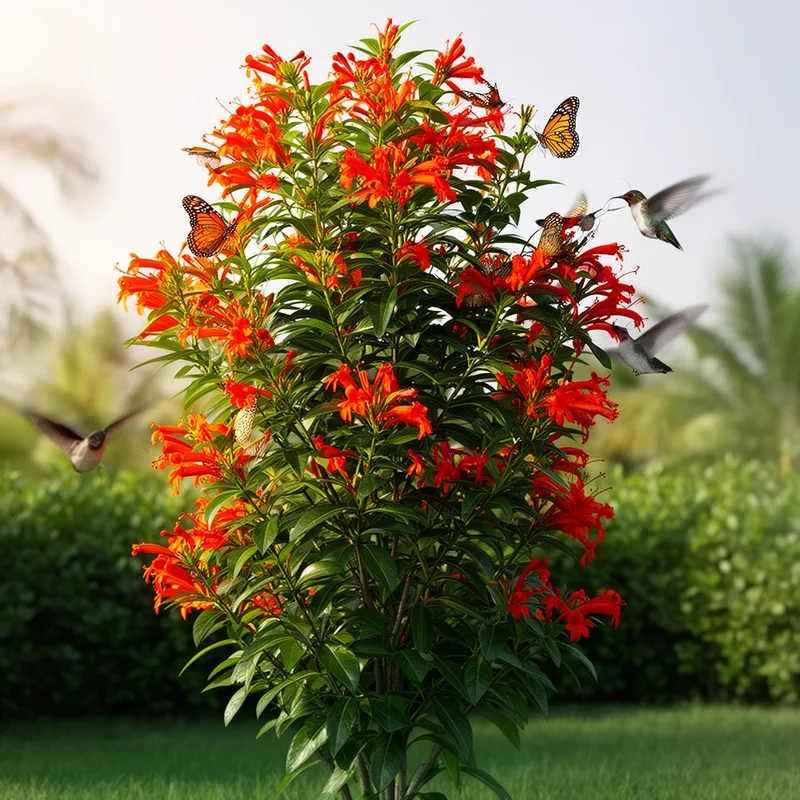
Hamelia patens
- noun
- Specialized
- In some regions, Hamelia patens is commonly planted as an ornamental hedge.
Examples
-
The Hamelia patens in her garden blooms with vibrant red flowers throughout the summer.
-
Butterflies and hummingbirds are often attracted to the bright blossoms of Hamelia patens.
-
The Hamelia patens blooms beautifully in the summer.
-
Many gardeners love the Hamelia patens for its vibrant colors.
-
The vibrant flowers of Hamelia patens attract many butterflies throughout the summer.
-
In our garden, Hamelia patens blooms with stunning orange flowers that brighten up the landscape.
-
The plant known as Hamelia patens is commonly seen in tropical regions for its striking floral display.
Synonyms
A tropical shrub with bright orange-red flowers that attract hummingbirds
A shrub with bright red or orange flowers that attracts hummingbirds

A bush with bright red or orange flowers that grows in warm places
Surface Forms
Morphology
hamelia + patens
This is a Latin binomial species name used as a proper noun; even if a learner knows 'hamelia' as a shrub, the second element 'patens' is not a productive English word here and does not convey the plant's features or distribution. Scientific names are lexicalized labels and must be learned as whole units rather than derived compositionally, so a B1 learner would not be able to infer the meaning from the parts.
Etymology
Hamelia patens is named after an early plant scientist called Hamel, and the Latin word patens means 'spreading' or 'open'. That's why the name gives a simple picture of a shrub with wide, open flowers and a spreading habit that attracts butterflies and hummingbirds.

