
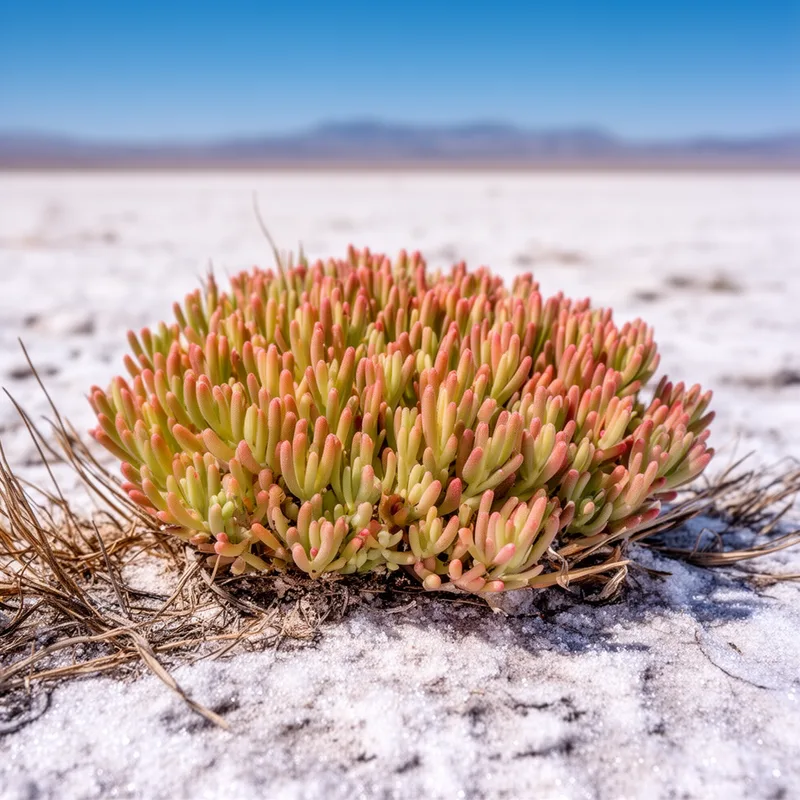
Halogeton
- noun
- /ˈhæloʊɡɪtən/
- Specialized
- The Halogeton plant thrives in salty environments.
Examples
-
A botanist collected samples of Halogeton while studying salt desert flora.
-
Invasive Halogeton has been a problem for rangeland management in certain regions.
-
Halogeton species are well adapted to survive in areas with high soil salinity.
-
Many species of Halogeton are found in arid regions.
-
Researchers discovered that Halogeton plants can grow in soils with very high salt concentrations.
-
The Halogeton species is important in studies of plant adaptation to alkaline environments.
-
In areas where most plants struggle, Halogeton thrives due to its unique ability to tolerate saline conditions.
Compounds

- Specialized
A coarse annual plant that is poisonous to sheep and cattle when they eat it
Surface Forms
Morphology
Halogeton = halo + geton
This is a scientific genus name built from classical elements referring to saline habitat, but the components are not transparent to an average English learner.
Etymology
Halogeton comes from Greek parts halo- meaning 'salt' and -geton meaning 'neighbor' or 'one who lives near'. So a Halogeton is like a 'salt neighbor', a plant that grows in salty or alkaline soils.

