
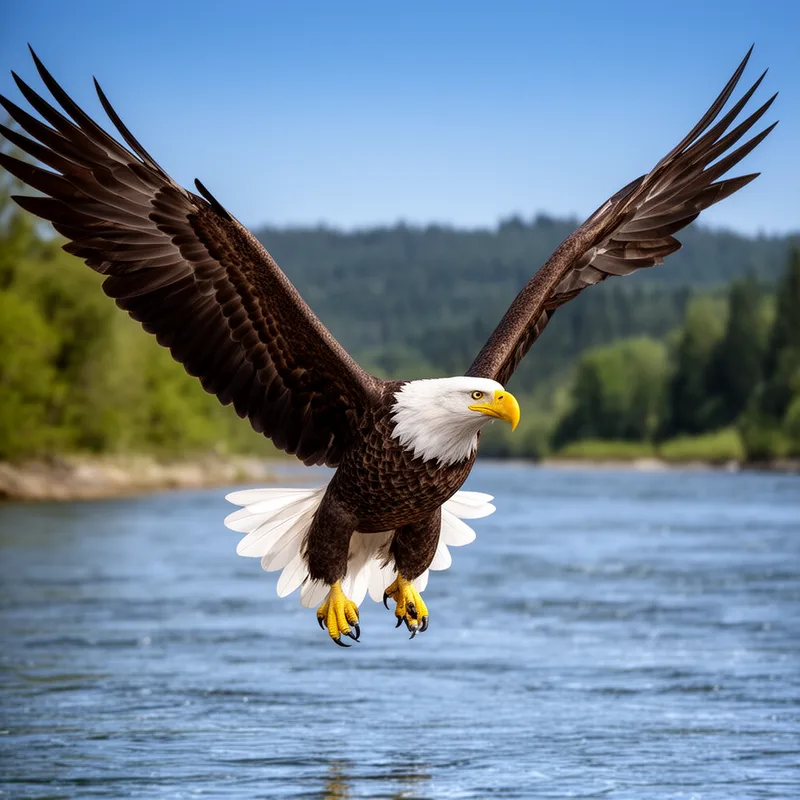
Haliaeetus leucocephalus
- noun
- /ˌhæl.iˈiː.təs ˌluː.kəʊˈsɛf.əl.əs/
- Specialized
- The Haliaeetus leucocephalus is easily recognized by its striking white head and yellow beak.
Examples
-
Strict protections have helped the population of Haliaeetus leucocephalus recover across the United States.
-
The Haliaeetus leucocephalus is a symbol of freedom in the United States.
-
A Haliaeetus leucocephalus soared over the river, searching for fish.
-
Many tourists come to see the Haliaeetus leucocephalus in its natural habitat.
-
A Haliaeetus leucocephalus soared gracefully above the lake, looking for its next meal.
-
The keen eyesight of the Haliaeetus leucocephalus allows it to spot fish from great distances.
-
During the summer, many people visit the coast to watch the Haliaeetus leucocephalus nest and raise their young.
Synonyms

 121
1.0
121
1.0

A large bird of prey with sharp talons and very good eyesight
 12
2.9
12
2.9
A large North American bird with a white head and tail and dark brown body, symbol of the United States


 1
3.0
1
3.0
A large North American bird with a white head and dark body that often eats fish
 1
9.9
1
9.9
A group of large sea eagles, for example the bald eagle

A group of large eagles that live near the sea and big lakes

A large eagle that lives near water and eats mostly fish
Surface Forms
Morphology
Haliaeetus + leucocephalus
The Latin binomial is compositional: it combines a taxonomic genus name (Haliaeetus, a group of sea/eagles) with a species epithet built from Greek roots meaning 'white-headed' (leuco- = white, -cephalus = head). If a learner knows the constituent elements, the overall meaning ('white-headed Haliaeetus' → bald eagle) is directly derivable, so the form is transparent.
Etymology
Haliaeetus leucocephalus comes from old Greek words: Haliaeetus means 'sea eagle' and leucocephalus means 'white head', so the name literally describes an eagle with a white head that lives by the water, which is the bald eagle you know today.