
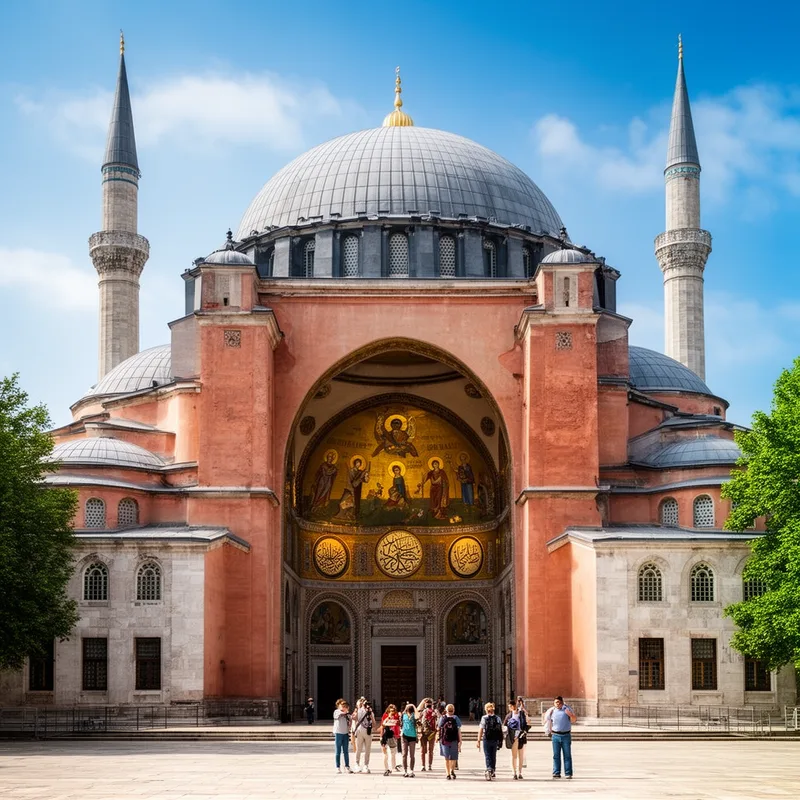
Hagia Sofia
- proper noun
- /ˈhɑːɡiə soʊˈfiə/
- The emperor Basil II's Armenian architect, Trdat, made major repairs, and Hagia Sophia was reopened in 996.
- Hagia Sofia Museum
- the sixth-century Hagia Sofia
Examples
-
Restoration of the dome mosaics is only one step in preserving Hagia Sophia.
Academic text (2003) -
Because of Hagia Sophia's long and complex history, no conservation or restoration project is simple.
Academic text (2003) -
What are the prospects for Hagia Sophia as it approaches its first century as a museum open to all?
Academic text (2003) -
"There should be a special team only for the conservation of Hagia Sophia," says Ozil.
Academic text (2003) -
But this is by no means a doomsday scenario for the city or Hagia Sophia.
Academic text (2003) -
And the work at Hagia Sophia must be placed in the larger context of restoration in Istanbul.
Academic text (2003) -
The repairs took two-thirds the time of the original construction, but finally, on December 24, 563, Hagia Sophia was reconsecrated.
Academic text (2003) -
The Fossati Brothers' restoration of the interior of Hagia Sophia from 1847 to 1849 was a marvel in terms of speed.
Academic text (2003) -
Fourteen centuries after Hagia Sophia was built, Mainstone headed a UNESCO mission inspecting the condition of the church and its mosaics.
Academic text (2003) -
The stunning architecture of Hagia Sofia has made it a UNESCO World Heritage Site.
Synonyms

A large old building in Istanbul that was a church, then a mosque, and now a museum

A large historic building in Istanbul that was a church, then a mosque, and now a museum
A large old building in Istanbul that was a church, later a mosque, and now a museum
Surface Forms
Morphology
Hagia + Sofia
Hagia Sofia is a language-specific proper name whose elements are not English lexical items in the provided data; even if a learner knew the literal roots (e.g. 'holy' + 'wisdom'), that would at best suggest a religious or dedicatory phrase but would not allow a B1 learner to infer the specific referent (a 6th-century Byzantine church/museum in Istanbul) or its historical status. Proper names like this are therefore non-compositional for learners and function idiomatically, making the expression opaque.
Etymology
Hagia Sofia gets its name from the Greek words Hagia and Sofia, which mean 'Holy Wisdom'. Built as a huge church in the 6th century, then a mosque, and later a museum, it now shows the city's layers of history and different religions.

