
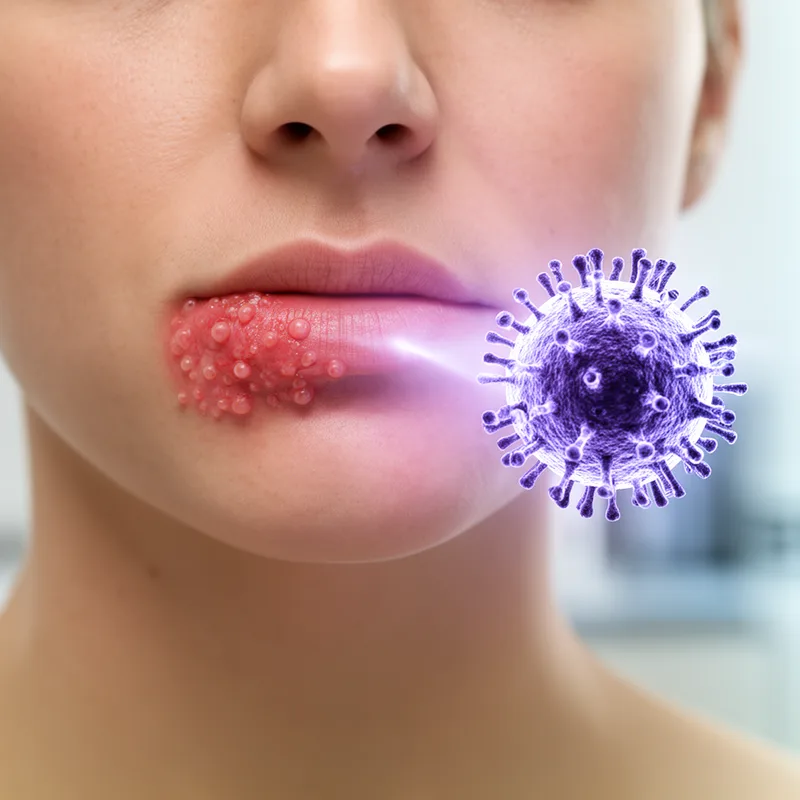
HSV-I
- noun
- /ˌeɪtʃ ɛs vi ˈaɪ/
- Specialized
- HSV-I is the most common cause of cold sores around the lips and mouth.
Examples
-
Many people carry HSV-I without symptoms.
-
Unlike HSV-2, HSV-I is more frequently transmitted by nonsexual contact.
-
Doctors diagnose oral herpes by detecting the presence of HSV-I in a patient's lesion.
-
She was diagnosed with HSV-I last week.
-
HSV-I is the leading cause of cold sores around the mouth.
-
Many adults have HSV-I and may not even know they are infected.
-
A doctor confirmed that HSV-I was the cause of her recurring mouth sores.
Synonyms

A virus that usually causes cold sores around the mouth

A virus that usually causes cold sores around the mouth

A virus that causes cold sores around the mouth
Surface Forms
Morphology
HSV-I = H + S + V + I
This is an acronym (initialism) composed of letters and a numeral; the component letters do not convey the meaning to learners and are not productive morphemes.
Etymology
HSV-I stands for herpes simplex virus, where herpes comes from an old Greek word meaning 'to creep' and simplex means 'simple' or 'one'. So HSV-I is the virus that often 'creeps' back on the lips as cold sores, and calling it type 1 shows it is one kind of this virus.

