
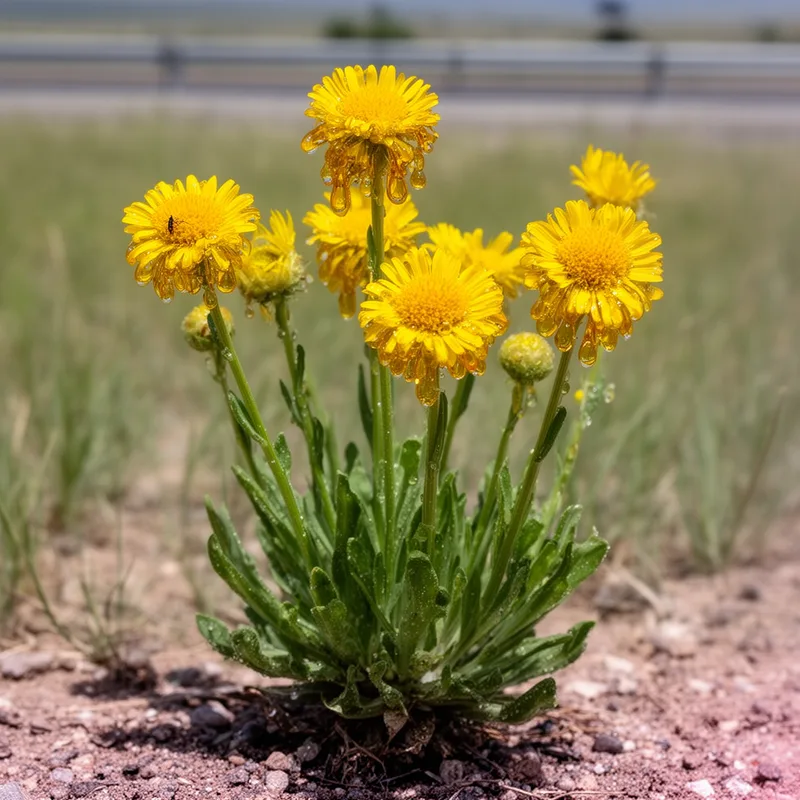
Grindelia squarrosa
- noun
- Specialized
- Grindelia squarrosa grows abundantly in prairies and along roadsides throughout the Midwest.
Examples
-
Native Americans traditionally used Grindelia squarrosa for its medicinal properties.
-
Botanists recently discovered several new populations of Grindelia squarrosa in Colorado.
-
Look at how the Grindelia squarrosa sways in the wind!
-
I found a patch of Grindelia squarrosa in the field.
-
Grindelia squarrosa is often found in the wild, attracting pollinators with its bright yellow flowers.
-
The sticky resin of Grindelia squarrosa can be used to treat minor skin ailments.
-
In early summer, Grindelia squarrosa blooms across the fields, adding a splash of color to the landscape.
Synonyms
A plant that lives many years with sticky yellow daisy-like flowers and curled leaf parts on prairies and poor soil

A western North American plant with sticky sap and yellow flowers that can poison livestock
A western American plant with sticky leaves sometimes used as medicine but poisonous to animals
A group of sticky herbs in the daisy family with yellow flowers

A North American plant with sticky leaves and yellow flowers used in traditional medicine

Plants with sticky leaves and a strong smell that grow in western North America
Surface Forms
Morphology
Grindelia + squarrosa
This is a Latin binomial (a scientific species name) where the overall referent is a proper noun rather than a compositional English phrase. The second element 'squarrosa' is a Latin epithet (not a productive English word and not defined here), so a B1 learner—even if they knew 'Grindelia' as a plant genus—would not be able to derive the full meaning from the parts. Therefore the name functions idiomatically/properly and is not transparently interpretable by typical learners.
Etymology
Grindelia squarrosa is a plant name that mixes a person's name and a Latin word: Grindelia honors a botanist, while squarrosa means 'rough' or 'spreading', which fits its stiff, bristly leaves. That's why the sticky, yellow 'gumweed' name helps you picture how the plant looks.

