

Great Schism


 1
9.9
1
9.9
- noun
- /ɡreɪt ˈskɪzəm/
- The following articles appear in Vol. 39, No. 8 (September 2010): Daniel S. Hamilton, "The Roman Primacy: From Second Constantinople (553) to the Great Schism (1054)," pp. 1-13.
Examples
-
It was the year of the Catholic Church's Great Schism.
Academic text (2004) -
The Church was one, with the Pope being the Patriarch of Rome; nothing further, first among the other equals of patriarchs; the Holy Spirit proclaimed as proceeding from the Father only, until the year 1054 when the Great Schism occurred; Rome broke away from the established Church.
Blog text (21) -
By that dramatic act, the Church was split in two in the Great Schism that has ever since divided East and West.
Blog text (30) -
The first great schism in the history of Christianity was thus as much political as it was theological.
Academic text (1996) -
Then came the "Great Schism" which separated the church into Eastern (Orthodox) and Western (Catholic) divisions in 1054.
Blog text (7) -
People like Teddy never stop assessing everyone around them for wit, intelligence, insight, and knowledge, and God help the person who forgets for a moment who all the Popes were during the Great Schism and the dates and places Councils were held to try to heal it.
Fiction book (1995) -
Although I did want to point out that when people give an overview of the history of schism, they tend to set the start at the Great Schism and forget the Oriental Orthodox who split off in the 5th century over Chalcedon (and remain a sizable group today).
Blog text (7) -
If it is heretical, the entire Church has fallen into heresy, and because all bishops within the Church are post-VII, there really is no way for it to recover or even know if this has happened before (e.g., during the Great Schism or Vatican I).
Blog text (4) -
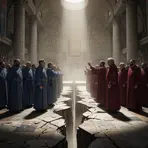
The Great Schism, marked by rival popes in Rome and Avignon, lasted from 1378 to 1417 and divided the Roman Catholic Church.
-
During the Great Schism, two different popes claimed authority, creating a significant division within the Catholic Church.
Synonyms
 18
8.7
18
8.7
A serious split in a group when people have different beliefs or opinions

A split in the Catholic Church from 1378 to 1417 when rival popes ruled from Rome and Avignon
Surface Forms
Morphology
The components 'great' (major) and 'schism' (a division) transparently yield the general sense of an important split, so a B1 learner who knows both words would likely infer 'a major division'. However, the capitalized phrase names a specific historical event (the papal rivalries 1378–1417) with details that are not derivable from the parts and require background knowledge, so the item is only partially predictable.
Etymology
Great Schism uses the word schism, which means a 'split', to paint a simple picture of a very big break in the Church. From 1378 to 1417 rival popes in Rome and Avignon both claimed to be the true leader, so the name reminds us that this was a long period of 'division' in the Roman Catholic Church.