

Gomphrena globosa
- noun
- /ɡɒmˈfriːnə ɡloʊˈboʊsə/
- Specialized
- I bought some Gomphrena globosa seeds for my garden.
Examples
-
The Gomphrena globosa flowers are vibrant and long-lasting.
-
The Gomphrena globosa is prized for its vibrant flowers that do not fade after drying.
-
Many gardeners grow Gomphrena globosa for use in floral arrangements because of its long-lasting blooms.
-
You can often find Gomphrena globosa in tropical gardens because it thrives in hot, sunny climates.
-
Gomphrena globosa produces vibrant Gomphrena globosa flowers that can last for months even after being dried.
-
Gardeners often use Gomphrena globosa to add a splash of color to their flower arrangements.
-
In tropical gardens, Gomphrena globosa thrives and blooms beautifully throughout the summer.
Synonyms
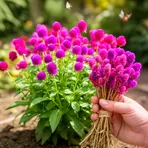
A tropical plant with round bright flowers that keep their color when dried

A tropical plant with bright rose, red, or purple flowers that keep their color when dried
Surface Forms
Morphology
Gomphrena + globosa
This is a Latin binomial: 'Gomphrena' designates the genus (tropical herbs with colorful flower heads) and 'globosa' is a Latin adjective meaning 'globose' or 'round', so a learner who actually knows both constituents could infer a round/globe-shaped Gomphrena (globe amaranth). However, 'globosa' is not a common English word and the construction is a technical taxonomic name, so typical B1 learners knowing only ordinary English vocabulary would not reliably derive the meaning without botanical or Latin knowledge.
Etymology
Gomphrena globosa comes from Greek and Latin words: Gomphrena from a word for a small 'peg' or 'nail' and globosa meaning 'round' or 'globe'. The name gives a clear picture of tiny, peg-like flower clusters that form round, globe heads, which is why people call it the 'globe amaranth' and notice its long-lasting, colorful blooms.

