
Gini


 1
6.9
1
6.9
- noun
- /ˈdʒiːni/
- Specialized
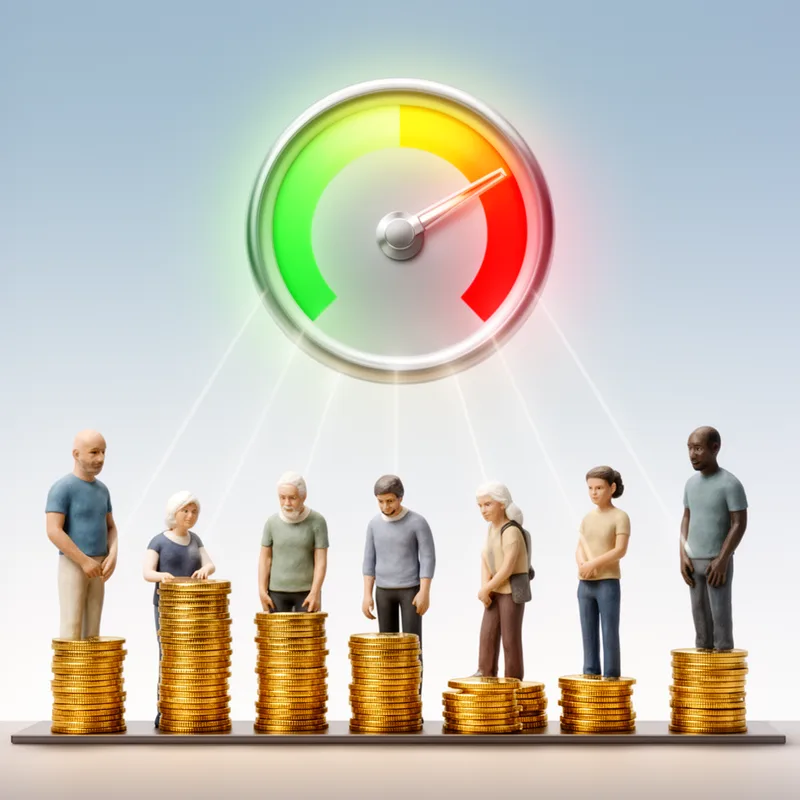
- Researchers use the Gini index to measure how wealth is distributed among the population.
- Gini index
- Gini coefficient
Loading YouTube…
Watch on YouTubeAt one point, China was more unequal than the United States by measure of what's called the Gini coefficient, which measures inequality.
- At one point, China was more unequal than the United States by measure of what's called the Gini coefficient, which measures inequality.
Examples
-
The Gini coefficient is often used to analyze income inequality within a country.
-
The inequality of income distribution (estimated in Gini indices) has steadily increased from 0.497 in 1960 to 0.59 in 1980 and up to 0.602 in 1987.
Academic text (1993) -
Relative patterns of land concentration may be measured using the Gini index of inequality.
Academic text (2002) -
We placed first in the world for the widest rich poor income gap based on the Gini coefficient.
-
Countries with identical Gini indices can differ greatly in wealth.
Academic text (2014) -
At one point, China was more unequal than the United States by measure of what's called the Gini coefficient, which measures inequality.
-
Rising Gini indices of income inequality and related measures indicate, however, that the latter alternative is the most plausible.
Academic text (2003) -
(The Gini coefficient of land distribution was as high as 0.793 in 1984).
Academic text (1998) -
Actually, the Washington Census MSA has one of the lowest household-income Gini indexes (Table 4 on page 7) among large US metro areas.
Blog text (1) -
(Its Gini index, a measure of income inequality on a scale of zero to 100, is 33, compared to 41 for the United States, 45 for China, and 59 for Brazil.)
Academic text (2006)
How Unequal

Surface Forms
Etymology
Gini as in the Gini index is named after the Italian statistician Corrado Gini and it is a 'measure of inequality' that shows how evenly things like income or wealth are shared. So a low Gini means more equal sharing and a high Gini means more unequal sharing.