

Georgia bark
- noun
- /ˈdʒɔrdʒə bɑrk/
- US
- The Georgia bark has long been valued for its medicinal properties, particularly as a remedy for fevers.
Examples
-
The Georgia bark tree thrives in swampy areas.
-
Many herbalists use Georgia bark for its medicinal properties.
-
Extracts from Georgia bark were historically important in traditional Southern medicine.
-
We identified several Georgia bark trees thriving near the edge of the swamp.
-
Extracts from Georgia bark were historically important in traditional Southern medicine.
-
The Georgia bark has long been valued for its medicinal properties, particularly as a remedy for fevers.
-
Many herbalists use Georgia bark for its medicinal properties and treatment of fever.
Synonyms
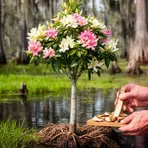
A small tree with bark used for fever and large pink or white flowers that grows in southeastern US swamps

A small shrub with large pink sepals that people use as medicine for fever
Surface Forms
Morphology
The compound combines the place name 'Georgia' with 'bark' (the outer covering of a tree), so a learner who knows both words will readily infer it refers to a type of bark or tree associated with Georgia. While the precise botanical and medicinal details are lexicalized, the basic referential meaning (a plant/tree bark from Georgia) is directly derivable and follows common compositional patterns.
Etymology
The plant name Georgia bark comes from the state of Georgia, where people long ago stripped the tree's bark and made a tea to treat fevers. Because the bark was used as a simple folk 'medicine' to lower a 'fever', the name reminds us of that healing use.

