
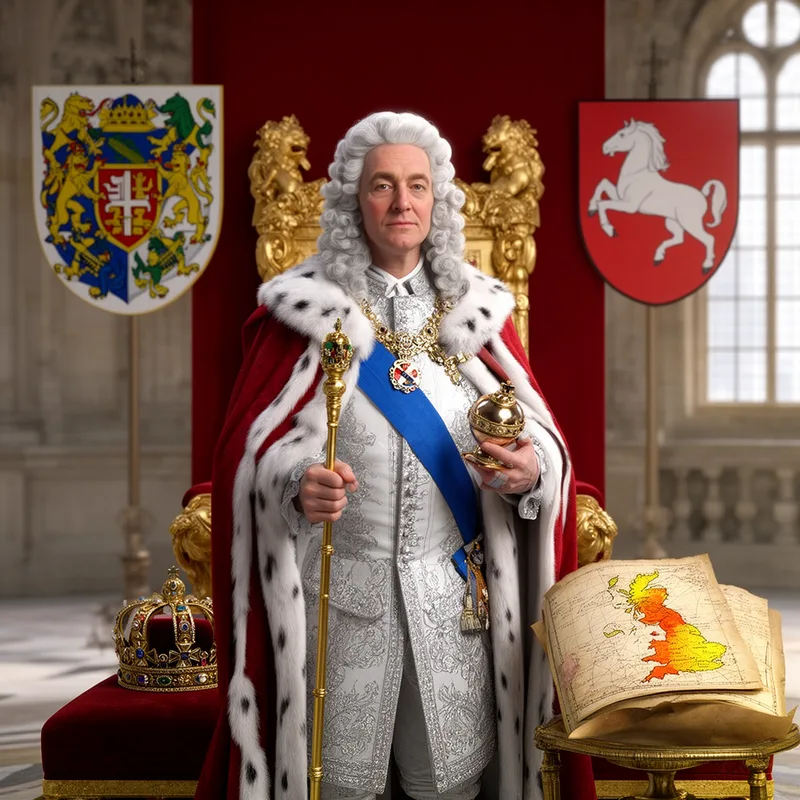
George I


 1
7.4
- proper noun
- George I ascended to the throne in 1714 following the death of Queen Anne.
Examples
-
Many political changes occurred during the rule of George I.
-
King George I ruled from 1714 to 1727.
-
The reign of George I marked the beginning of the Hanoverian dynasty in Britain.
-
George I was the first Hanoverian king of Britain.
-
During George I's reign, the British Parliament began to develop more power.
-
Historians often discuss the impact of George I on the politics of early 18th century England.
-
The ascension of George I marked the beginning of a new era in British history.
Surface Forms
Morphology
George + I
The form is a proper name combining the given name 'George' with the ordinal/roman numeral 'I', so a learner who recognises the numeral can infer 'George the First'. However, the specific historical identity and details (Elector of Hanover; first Hanoverian King of Great Britain and Ireland, reign dates) are world-knowledge that cannot be derived from the constituents alone, so the transparency is only partial.
Etymology
George I was a German ruler who became the first Hanoverian king of Britain in 1714. He spoke little English and often stayed in his home, Hanover, so he left everyday government work to his ministers, and his rule is remembered as the start of the 'Hanoverian dynasty' and a time when ministers gained more power.