
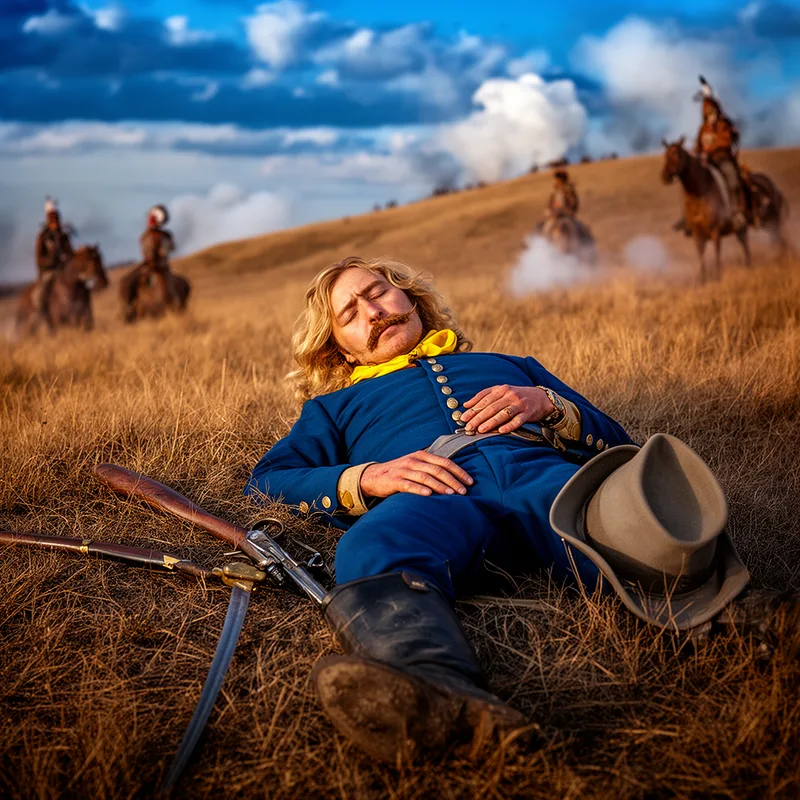
George Armstrong Custer
 1
6.5

- proper noun
- /ˈdʒɔrdʒ ˈɑrmstrɔŋ ˈkʌstər/
- The defeat of George Armstrong Custer at the Battle of the Little Bighorn became legendary in American history.
Examples
-
Many tourists visit the site where George Armstrong Custer made his last stand.
-
A biography of George Armstrong Custer explores his controversial military career and personal life.
-
Did George Armstrong Custer really believe he could defeat the Sioux?
-
How did George Armstrong Custer become a national figure?
-
The defeat of George Armstrong Custer at the Battle of the Little Bighorn remains one of the most discussed events in American history.
-
A biography of George Armstrong Custer details his leadership during key battles in the American Civil War.
-
Many citizens remember George Armstrong Custer for his controversial tactics and eventual downfall during the Indian Wars.
Synonyms
 14
8.9
A United States army officer who was killed at the Battle of Little Bighorn
 4
7.2
An American army general killed with his soldiers at the Battle of Little Bighorn by the Sioux
Surface Forms
Morphology
George + Armstrong + Custer
This is a proper name referring to a specific historical individual; the sense 'U.S. Army general defeated at Little Bighorn' is not compositionally derivable from the literal parts 'George', 'Armstrong', and 'Custer'. Identifying the referent requires cultural/historical knowledge rather than knowledge of the constituent words, so a B1 learner who only knows the parts would not infer the full meaning.
Etymology
George Armstrong Custer was a United States Army general who is best known for his defeat and death at the Battle of the Little Bighorn, where he and a small group of soldiers were surrounded. The strong image of his 'last stand' — a small force overwhelmed by a larger enemy — is why his name is remembered and often used when people talk about a famous defeat or a risky decision.