
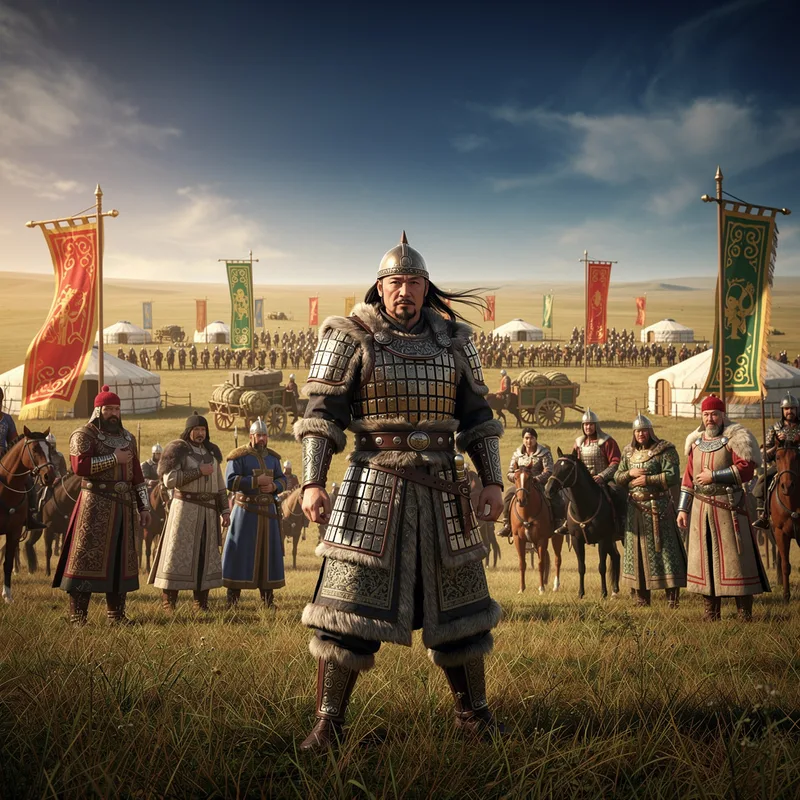
Genghis Khan
 17
5.1

- proper noun
- /ˈɡɛŋɡɪs kɑn/
- And when Tamerlane, Tamer the Lane invaded Syria, Tamer the Lane was one of Genghis Khan's descendants.
- the Mongol emperor Genghis Khan
- descendant of Genghis Khan
- empire founded by Genghis Khan
Loading YouTube…
Watch on YouTubeWell, I think that it's easy to imagine that most men could have become Genghis Khan.
- Well, I think that it's easy to imagine that most men could have become Genghis Khan.
Examples
-
The Mongols under Genghis Khan had overrun much of Asia.
-
So were Genghis Khan and Mao Tse-Tung.
Blog text (13) -
I actually think Genghis Khan is a pretty awesome historical figure.
Blog text (13) -
Genghis Khan was the third son of a minor tribal chief, and look what he was able to achieve.
Blog text (13) -
Their leader Batu was the grandson of Genghis Khan.
Fiction book (2001) -
The Mongols under Genghis Khan had overrun much of Asia.
-
1,500 years later, a maniac named Genghis Khan would slaughter every inhabitant of a city of 160,000 after it surrendered, just to make others afraid.
Blog text (10) -
Strategic bombing began as an attempt to find clever, scientifically informed ways to shut down the enemy's war-making capability, and it ended with a butchery that would have been recognizable to Genghis Khan.
Blog text (12) -
Genghis Khan unified the Mongol tribes and created one of the largest empires in history.
-
Many historians consider Genghis Khan to be one of the most effective military leaders of all time.
Synonyms
 1
9.5
The birth name of Genghis Khan, the Mongol leader who founded a large empire
A Mongolian ruler who founded the Mongol Empire and conquered lands in Asia and Europe
Surface Forms
Morphology
Genghis + khan
The element 'khan' is a transparent lexical clue meaning 'ruler', so a learner who knows that word can infer that 'Genghis Khan' is a person with a ruling/title role; however 'Genghis' is an arbitrary proper name with no predictable meaning and does not convey the historical specifics (founder, unifier, 13th-century ruler). Because part of the meaning (that this is a ruler) is recoverable from constituents but the full historical sense is not derivable, the expression is best assessed as partially transparent.
Etymology
Genghis Khan: The name comes from a title given to Temujin after he united the Mongol tribes, where Genghis + Khan gave the idea of a 'universal ruler'. That's why the name brings to mind a single powerful leader who joined many peoples and founded a huge empire.