

Fraxinus velutina
- noun
- Specialized
- The Fraxinus velutina thrives in the arid climates of Arizona and New Mexico.
Examples
-
Botanists studied the Fraxinus velutina to understand its adaptation to dry environments.
-
Many gardeners prefer Fraxinus velutina for its drought resistance.
-
The landscaping project featured several Fraxinus velutina along the southern boundary.
-
The Fraxinus velutina is commonly found in arid regions.
-
The Fraxinus velutina is well-suited for gardens in dry areas due to its ability to thrive in low water conditions.
-
In the desert landscape, the Fraxinus velutina adds greenery and shade, making it a popular choice among landscapers.
-
Known for its resilience, the Fraxinus velutina is commonly planted in parks and residential areas across the southwestern United States.
Synonyms
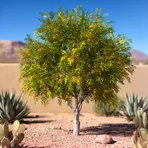
A small ash tree with many branches that grows in dry parts of the southwestern United States and northwest Mexico
Surface Forms
Morphology
Fraxinus + velutina
This is a Linnaean binomial: the genus name 'Fraxinus' (ash) combined with a species epithet yields the meaning 'a species/variety of ash.' The composition follows a standard, cross-linguistic scientific naming pattern so a learner who knows the constituent parts can readily infer it denotes a particular kind of ash tree.
Etymology
Fraxinus velutina is a Latin name that describes the tree: Fraxinus means 'ash' and velutina means 'velvety', which points to its soft, hairy leaves or twigs. So the name helps you remember this small, shrubby ash that grows in the dry parts of the southwestern United States and northwestern Mexico.

