
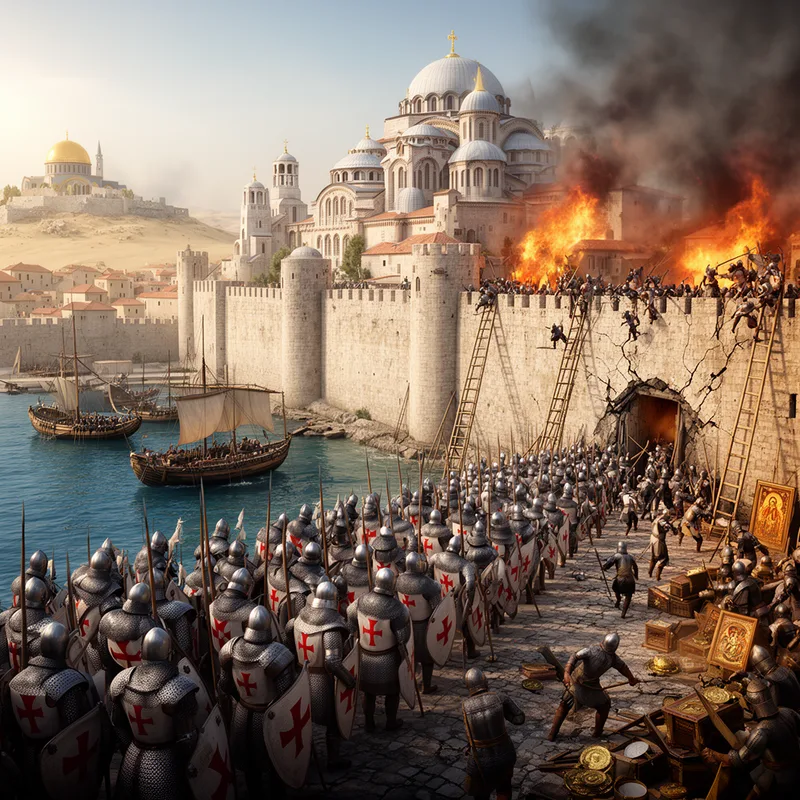
Fourth Crusade


 1
9.6
1
9.6
- proper noun
- After the Fourth Crusade, many valuable artifacts from Constantinople were taken to Europe, marking a significant cultural shift.
Examples
-
In 1204, events had conspired to lead the Fourth Crusade off its path, ending with its capture of Constantinople from the Eastern Roman Empire and the establishment of the so-called Latin Empire.
Blog text (32) -
The Fourth Crusade, which took place from 1202 to 1204, ultimately led to the sack of Constantinople instead of its original goal of recapturing Jerusalem.
-
Bitterness between the two sides had been increasing for years before the disaster of the Fourth Crusade.
Blog text (10) -
Dandolo, the Venetian leader of the Fourth Crusade, was buried there in 1205 (above).
Academic text (2003) -
In the chaos that surrounded the Fourth Crusade, a branch of the old Imperial family, the Komnenoi, had established themselves as independent rulers on the coast of the Black Sea.
Blog text (32) -
The church's schematic representation shows a single arch of the central portal crossing into the attic level to support the four antique Roman bronze horses brought to the city after the Fourth Crusade.
Academic text (2008) -
The Shroud of Turin, purported to be the burial cloth of Jesus Christ, was reportedly stolen from Constantinople and taken to France during the Fourth Crusade.
Fiction book (2002) -
Following the Fourth Crusade in 1204, a multitude of Byzantine luxury objects, both secular and sacred, were removed from Constantinople and eventually found their way into ecclesiastical and private collections in the West.
Academic text (2008) -
During the Fourth Crusade, the knights significantly changed the power dynamics in the region by capturing Constantinople.
Surface Forms
Morphology
The term is fully compositional: 'fourth' (ordinal) + 'crusade' (medieval military expedition) clearly signals the fourth instance of such an expedition, so a learner who knows the constituents can derive its basic referential meaning. This ordinal + event-name pattern is cross-linguistically common; learners may not know the specific historical details (e.g., the sack of Constantinople) but the core meaning is transparent.
Etymology
Fourth Crusade name marks the fourth large Christian expedition 'to recapture Jerusalem', but the memorable story is that the army never reached Jerusalem and instead attacked the city of Constantinople and sacked it in 1204. That's why the Fourth Crusade is remembered as a shocking failure that changed history.