
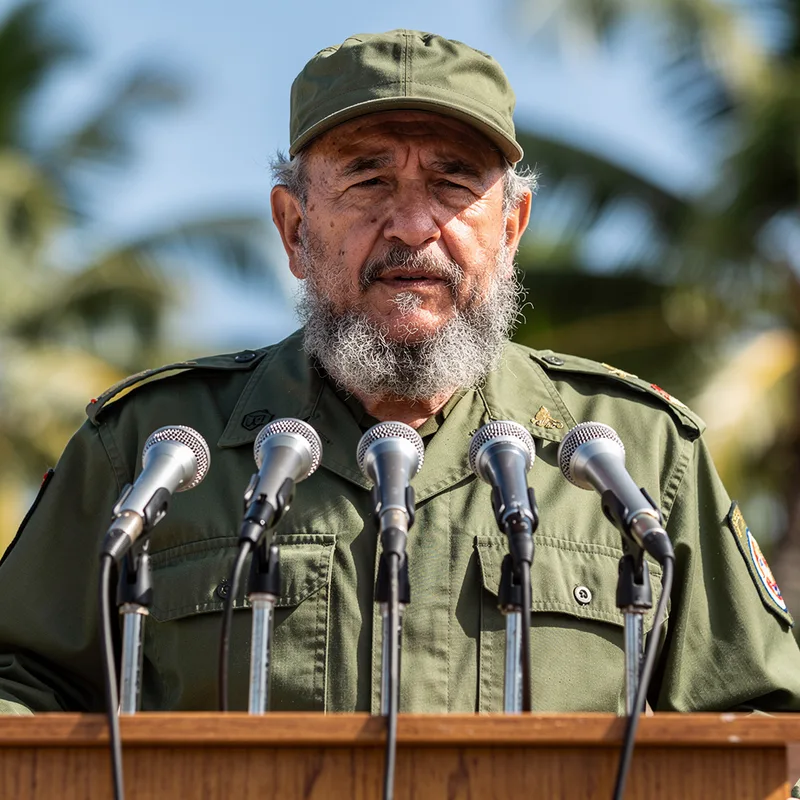
Fidel Castro
 59
3.7

- proper noun
- /fiˈdɛl ˈkæstroʊ/
- Fidel Castro governed Cuba for nearly five decades after overthrowing the Batista regime.
- President Fidel Castro
Examples
-
Instead, through the reinforcement of the United States trade embargo, the administration hoped to pressure democratic reforms, if not eliminate Fidel Castro once and for all.
Academic text (1998) -
As 1958 wore on, faute de mieux, Fidel Castro became the logical and inevitable focus of opposition sentiment.
Academic text (1994) -
While Smith seems not to have bought the Communist charges, he did feel that the United States could not do business with Fidel Castro.
Academic text (1994) -
For the last three decades, sport has been used by Fidel Castro to the utmost advantage.
Academic text (1994) -
Fidel Castro's revolution had succeeded in Cuba two years earlier.
Academic text (2005) -
How could the United States plot to assassinate Fidel Castro, president of a sovereign state?
Academic text (1994) -
Towards this end, Gutierrez Menoyo met with Fidel Castro in 1995.
Academic text (1998) -
Since 1959, Fidel Castro has presided over unprecedented growth and mastery of a long list of international sports.
Academic text (1994) -
Fidel Castro still commands an authoritarian political system and a statist economy.
Academic text (1997) -
Simultaneously, as the twentieth century draws to a close, the response to Fidel Castro's rhetoric has gone from enthusiasm to ridicule.
Academic text (1997)
Synonyms
 199
5.5
A Cuban revolutionary and political leader who led a socialist government after a 1959 revolution

 1
3.0
A Cuban leader who led the 1959 revolution and ruled Cuba as a socialist president
Surface Forms
Morphology
Fidel + Castro
This is a proper name referring to a specific historical person, so its identity and biographical meaning are not compositionally derived from its parts. Even if a learner knows the individual tokens 'Fidel' and 'Castro', they cannot infer he was the Cuban socialist leader who overthrew Batista, so the expression is opaque to a B1 learner.
Etymology
Fidel Castro is a Cuban leader whose name comes from Spanish roots: Fidel means 'faithful' and Castro comes from a word for a 'fort' or 'castle'. He led the 1959 revolution and then ruled Cuba for decades, so today the name stands for that man and his government.