
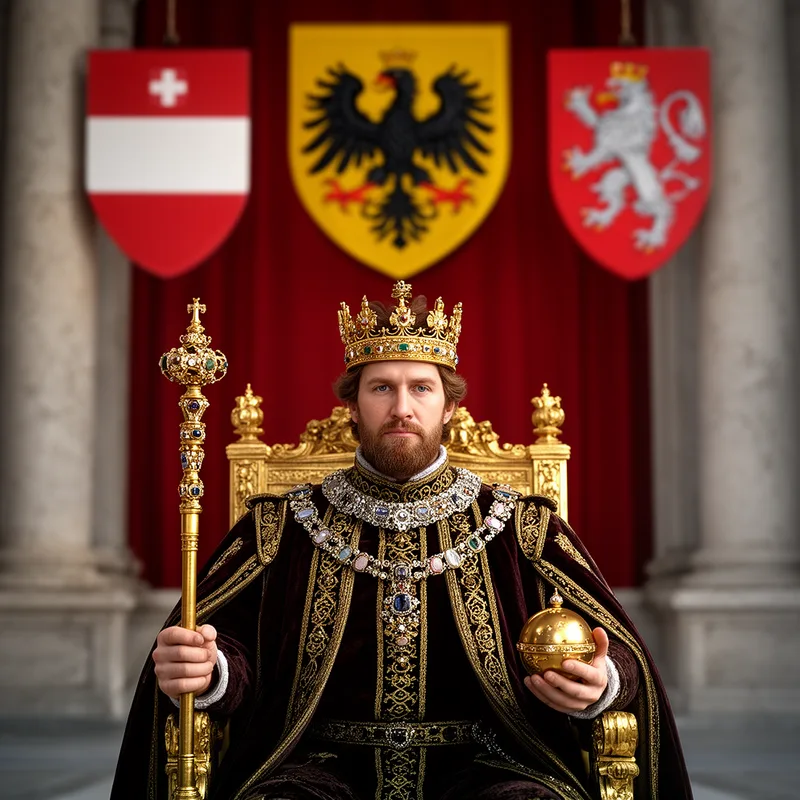
Ferdinand I
 1
9.5

- proper noun
- In 1547, Ferdinand I became King of Bohemia, further expanding his influence in Central Europe.
Examples
-
Ferdinand I was crowned Holy Roman Emperor in 1558 after the abdication of his brother Charles V.
-
The Treaty of Augsburg in 1555 was signed during the reign of Ferdinand I.
-
Historians credit Ferdinand I with shaping the Habsburg monarchy's future in Central Europe.
-
Did Ferdinand I influence the politics of Central Europe?
-
What were the main achievements of Ferdinand I?
-
Ferdinand I strengthened the Habsburg dynasty during his rule as Holy Roman Emperor.
-
Ferdinand I allied with various European powers to maintain peace during his reign.
Surface Forms
Morphology
Ferdinand + I
This is a named historical person: 'Ferdinand' is a proper name and 'I' is a numeral indicating 'the first', so knowing the constituents might let a learner infer it's a person called Ferdinand the First but not that he was Holy Roman Emperor and king of Hungary and Bohemia. The specific historical and political meaning cannot be derived from the parts and requires encyclopedic knowledge, so it is not compositionally transparent to a B1 learner.
Etymology
Ferdinand I was a ruler in the 1500s from the Habsburg family who became Holy Roman Emperor and king of Hungary and Bohemia after his brother gave up the throne. The I in his name shows he was the 'first' ruler named Ferdinand to hold those titles, so the name tells you who he was and his place in history.