
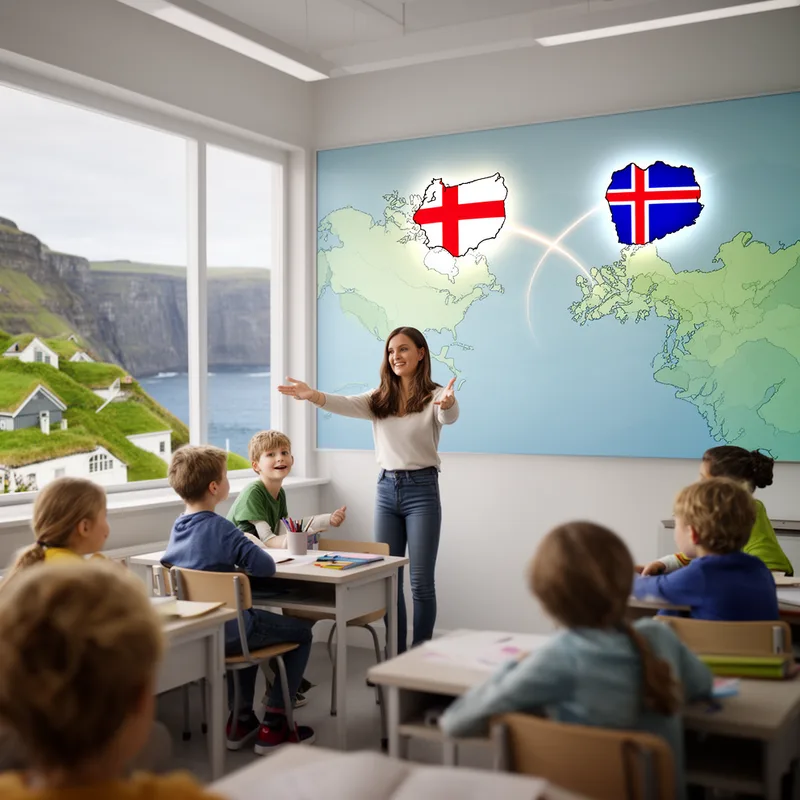
Faroese language
- noun
- The Faroese language has preserved many features of Old Norse.
Examples
-
She is fluent in both Icelandic and Faroese language.
-
Children in the Faroe Islands are taught the Faroese language from a young age.
-
The Faroese language is unique to the Faroe Islands.
-
Many people are learning the Faroese language online.
-
Children in the Faroe Islands are taught the Faroese language from a young age.
-
The Faroese language has preserved many features of Old Norse.
-
Many people are learning the Faroese language online.
Synonyms


 1
5.3
A language spoken in northern Europe, for example Swedish or Danish
 1
6.6
A group of languages spoken in Denmark, Norway, Sweden, Iceland, and the Faroe Islands
 1
8.6
A language spoken on the Faroe Islands similar to Icelandic
 1
9.9
A language spoken in the Faroe Islands, similar to Icelandic
 1
7.6
A language spoken in Scandinavia and Iceland, like Swedish or Danish
 1
7.7
A group of languages spoken in Denmark, Sweden, Norway, Iceland, and the Faroe Islands
Surface Forms
Morphology
The noun phrase combines the demonym/identifier 'Faroese' with the generic noun 'language', so its meaning—'the language spoken by Faroese people/in the Faroe Islands'—is directly and compositionally derivable from the parts. This demonym + language pattern is cross-linguistically common and follows standard noun phrase composition, making it immediately understandable to a B1 learner who knows the constituents.
Etymology
Faroese language comes from the speech Norse people brought to the Faroe Islands long ago. Because the islands were small and far away, that speech kept many old words and sounds, so Faroese language today is still very close to Icelandic and to Old Norse.