
Faraday
 14
5.6

- proper noun
- /ˈfɛrəˌdeɪ/
- Pupils will also do depth learning on Michael Faraday's contributions in his day and presently to the world of science.
- Michael Faraday
- Faraday rotation
Loading YouTube…
Watch on YouTubeAfter all, they claimed there's a loophole in Faraday's argument.
- After all, they claimed there's a loophole in Faraday's argument.
- But that doesn't even begin to explain the story of Michael Faraday.
Examples
-
This is the nation of the industrial revolution, of Stevenson, of Whittle, Lovelace and Faraday, people whose ideas shape the world around them.
-
First of all, this entire room is a Faraday cage and no wires can go between it and the wall or it'll be sparks sitting in here.
-
Is Dr. Faraday in his office?
-
The noted scientist Michael Faraday wrote a letter to The Times on July 7, 1855.
Academic text (1992) -
I keep my preamplifier and the biological subject inside a Faraday cage, and it works well.
Blog text (2) -
This is a Faraday cage, which is meant to protect you from the harmful radio waves that you might encounter from your home wireless access point.
-
The local rate of copper deposition is proportional to the local current density i by Faraday's law.
Academic text (1998) -
After looking at Faraday's work and his untidy laboratory, Gladstone said to Faraday, "This is all very interesting, but what good is it?"
Academic text (1995) -
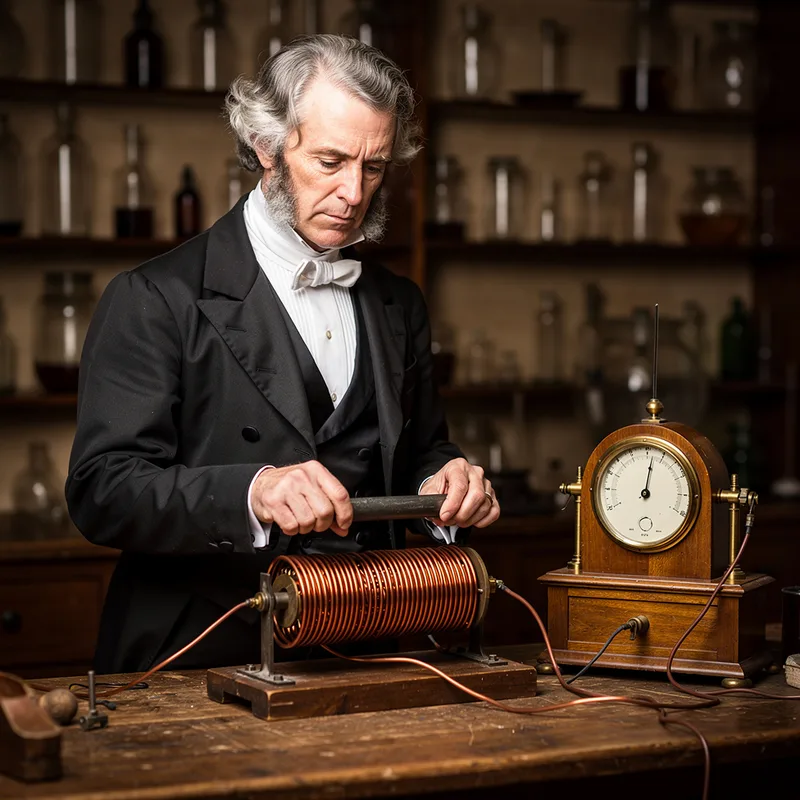
The noted scientist Faraday once demonstrated the principles of electromagnetic induction.
-
During his experiments, Faraday made groundbreaking discoveries that changed the field of physics.
Surface Forms
Etymology
Faraday is the last name of Michael Faraday, a famous English scientist who discovered how electricity and magnetism work together. His name is used for many electrical things, such as the unit farad and the 'Faraday cage', so Faraday now often means something to do with electricity.