
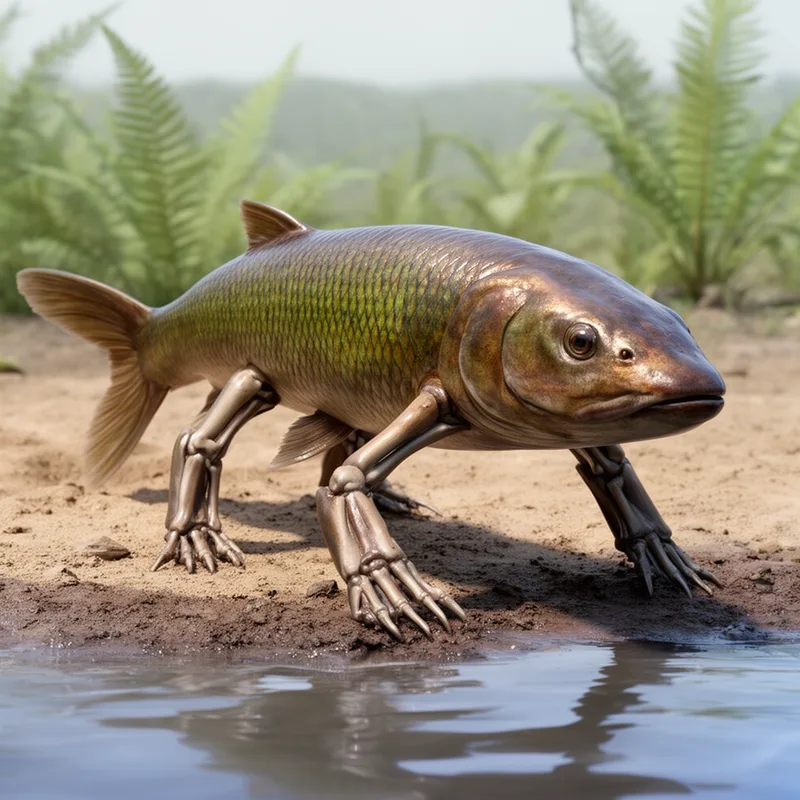
Eusthenopteron


 1
9.9
- proper noun
- /juːsˈθɛnəpˌtɛrən/
- Specialized
- Scientists study Eusthenopteron to understand the anatomical changes that occurred as fish evolved into tetrapods.
- Eusthenopteron, a fish
Examples
-
Paleontologists believe that Eusthenopteron played a crucial role in the evolution of vertebrates, bridging the gap between fish and early land animals.
-
The four animals shown below (not to scale) are (left to right): Eusthenopteron, Tiktaalik, Acanthostega, and Ichthyostega.
Academic text (2006) -
On the other side of the evolutionary divide was Eusthenopteron, a fish that was about ten million years older than Ichthyostega.
Academic text (2006) -
According to the simplest scenario of the day, a fish such as Eusthenopteron left one drying-up pool to find another and thus grew legs.
Academic text (2006) -
The story that land animals evolved when fishes such as Eusthenopteron emerged from the water to crawl over land and later developed limbs was just that: a story.
Academic text (2006) -
With Tiktaalik, an intermediate stage between finned Eusthenopteron and footed Ichthyostega has come into focus.
Academic text (2006) -
Compared to Eusthenopteron and similar fish, the pocket in which air was exchanged or stored had become enlarged, and some of the gill apparatus was already evolving toward the configuration that tetrapods eventually used for hearing.
Academic text (2006) -
In Eusthenopteron, paleontologists saw the model ancestor to the tetrapods: the skeleton of its fin seemed the archetype from which all limbs evolved, including our own.
Academic text (2006) -
Fossils of Eusthenopteron, an extinct lobe-finned fish, provide valuable insights into how vertebrates adapted to life on land.
Surface Forms
Etymology
Eusthenopteron comes from Greek parts: eu- 'good' or 'well', stheno- 'strength', and -pteron 'fin' or 'wing', so the name means something like 'strong fin'. A helpful way to remember it is that this extinct fish had strong, limb-like fins that help explain the move from water to land.