
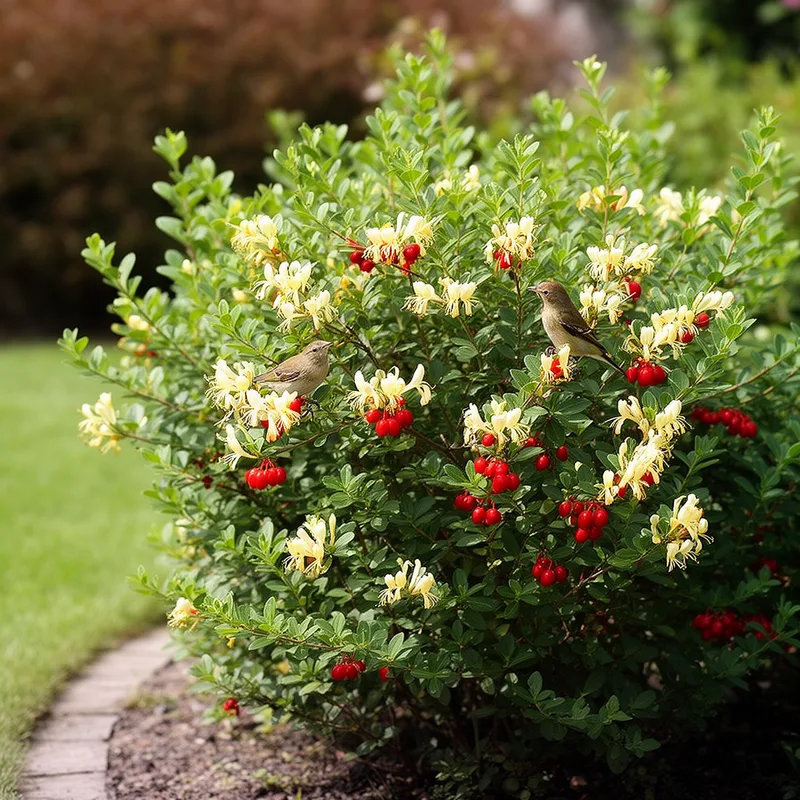
European fly honeysuckle
- noun
- UK
- Birds are drawn to the scarlet fruit of the European fly honeysuckle in late summer.
Examples
-
The European fly honeysuckle is often grown in gardens for its attractive berries.
-
The European fly honeysuckle blooms in early spring.
-
Some landscapes use European fly honeysuckle as a hedge for its ornamental value.
-
Many gardeners love the European fly honeysuckle for its beauty.
-
Birds are drawn to the scarlet fruit of the European fly honeysuckle in late summer.
-
Some landscapes use European fly honeysuckle as a hedge for its ornamental value.
-
The European fly honeysuckle is often grown in gardens for its attractive berries.
Synonyms

A honeysuckle bush with pale yellow flowers and red berries that are mildly poisonous
Surface Forms
Morphology
European + fly + honeysuckle
The phrase is compositionally transparent: 'European' signals origin and 'fly honeysuckle' is a noun compound where 'fly' modifies 'honeysuckle' to indicate a type or association of honeysuckle. A B1 learner who knows the three words can infer this refers to a kind of honeysuckle (a shrub) associated with 'fly' and originating from Europe, even if they cannot identify the exact botanical species.
Etymology
European fly honeysuckle gets its name from what people saw: the sweet flowers of the honeysuckle have nectar like 'honey', and the plant's bright berries and blooms often attract insects, so folk added fly to the name. That's why the name now means a shrub from Europe and Asia with yellow‑white flowers and red berries often grown for its looks.

