

European brooklime
- noun
- UK
- The stream was bordered with patches of European brooklime, its delicate blue flowers catching the sunlight.
Examples
-
In North America, European brooklime can be found naturalized in damp meadows and along riverbanks.
-
Gardeners often value European brooklime as a ground cover for wet, shady areas.
-
Look at the European brooklime!
-
The European brooklime is often found near water.
-
In North America, European brooklime can be found naturalized in damp meadows and along riverbanks.
-
Gardeners often value European brooklime as a ground cover for wet, shady areas.
-
The stream was bordered with patches of European brooklime, its delicate blue flowers catching the sunlight.
Synonyms

A plant with trailing stems and blue flowers that grows in wet places like stream banks
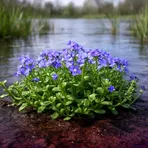
A low plant with thick stems and blue or violet flowers that grows in wet places
How Tall


Surface Forms
Morphology
The phrase is a straightforward adjective + noun combination: 'European' specifies origin or association and 'brooklime' names the plant, so the overall meaning is simply a brooklime from/connected with Europe. This follows a common compositional pattern (adjective modifying a noun) with no idiomatic or metaphorical shift, so a learner who knows both words will understand it.
Etymology
European brooklime may come from the plant's way of growing by small streams: brook means a small stream and lime is an old word used in plant names. Imagine a low plant lying along a brook with blue flowers near the water — so the name means 'a plant that grows by brooks' and shows it is a water-loving ground cover.