
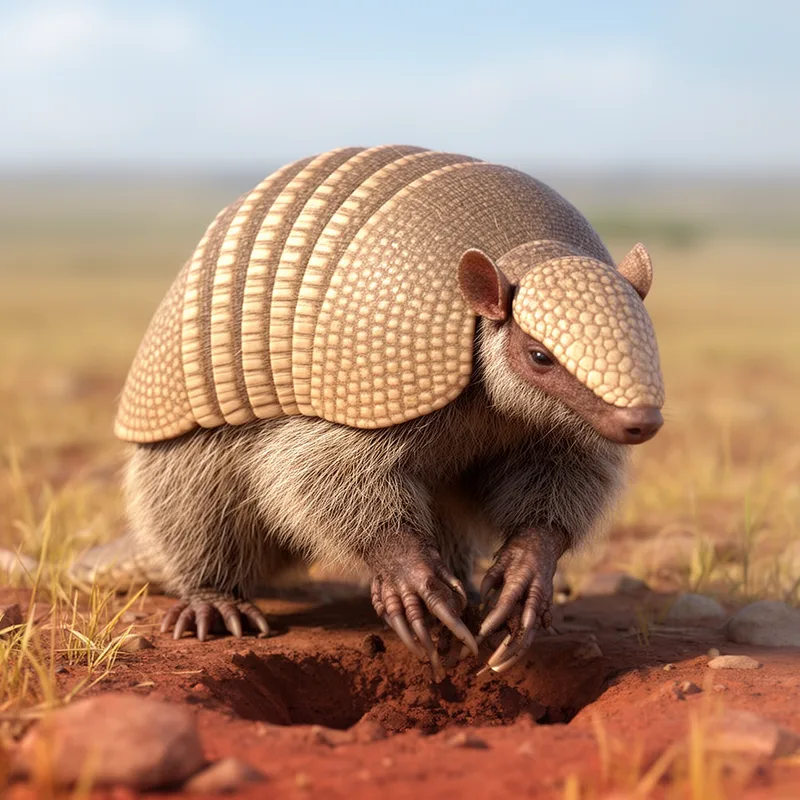
Euphractus sexcinctus
- noun
- Specialized
- The Euphractus sexcinctus is commonly known as the six-banded armadillo.
Examples
-
Did you know that the Euphractus sexcinctus has six movable bands?
-
Researchers observed the Euphractus sexcinctus digging for insects in its natural habitat.
-
Conservationists are studying the population trends of Euphractus sexcinctus across South America.
-
The Euphractus sexcinctus is often found in grasslands.
-
The Euphractus sexcinctus, or six-banded armadillo, has a unique appearance with its distinct bands.
-
In the wild, the Euphractus sexcinctus forages for insects and small invertebrates to eat.
-
The conservation efforts for the Euphractus sexcinctus aim to protect its natural habitat in South America.
Synonyms

An armadillo with six movable bands and hair on its belly
Surface Forms
Morphology
Euphractus + sexcinctus
This is a Latin scientific binomial; an average B1 learner who knows 'Euphractus' and sees 'sexcinctus' (which is not an English word) would not be able to derive that it denotes a six-banded armadillo. The apparent morphemes ('sex-' = six, 'cinctus' = banded) are Latin and require specialist/taxonomic or Latin knowledge, so the meaning is not transparently recoverable to general learners.
Etymology
Euphractus sexcinctus is a scientific name that describes the animal's look: sex means six and cinctus means 'banded', so the name points to the six movable bands on its shell. That's why it is called the 'six-banded armadillo' today.

