

Euclidean axiom
- noun
- /juˈklɪdiən ˈæksɪəm/
- Specialized
- The first Euclidean axiom states that a straight line can be drawn between any two points.
Examples
-
A Euclidean axiom is accepted without proof.
-
The parallel postulate is the fifth Euclidean axiom and uniquely distinguishes Euclidean geometry from non-Euclidean systems.
-
Each Euclidean axiom serves as an essential building block for developing geometric proofs.
-
Students are often introduced to the concept of a Euclidean axiom in high school geometry classes.
-
Each Euclidean axiom serves as a fundamental principle that underpins all geometric constructions.
-
In geometry, a Euclidean axiom provides a basic assumption on which theorems and proofs are based.
-
The first Euclidean axiom asserts that it is possible to draw a straight line between any two points on a plane.
Synonyms


 1
8.6
1
8.6
One of five basic statements that give the rules of geometry on flat surfaces
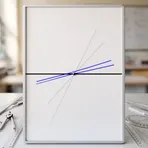
One of the five basic rules that make Euclidean geometry
Surface Forms
Morphology
The phrase combines the adjective 'Euclidean' (relating to Euclidean/flat geometry) with 'axiom' (a fundamental statement), so the meaning 'fundamental assumptions of Euclidean geometry' is directly derivable from the parts. This adjective+noun composition is a regular, cross-linguistically common pattern, so a B1 learner who knows both constituents will understand the MWE.
Etymology
Euclidean axiom comes from the Greek mathematician Euclid; Euclidean refers to his style of geometry and axiom means a simple, obvious rule. These clear rules were used as building blocks in geometry, so Euclidean axiom now means 'one of the basic assumptions' used in Euclidean geometry.