

Eucharistic liturgy
- noun
- /juˈkɛrɪstɪk ˈlɪtərdʒi/
- The Eucharistic liturgy celebrates the Last Supper, where bread and wine are blessed and shared among the attendees.
Examples
-
A sign of this separation of the West from its spiritual and moral patrimony is the diminution of religious practice, visible in participation in the Eucharistic liturgy and, even more, in the Sacrament of Penance.
Blog text (2) -
"It is the heart of the Eucharistic liturgy in which we celebrate the presence of God in Christ."
Academic text (2011) -
Anselm's mention of it reveals the deep devotion to the eucharistic liturgy which formed the center of his Benedictine spirituality. 48
Academic text (1992) -
During the Sunday service, the priest performed the Eucharistic liturgy, inviting the congregation to receive communion.
-
Every mass includes the Eucharistic liturgy, a moment when believers come together to remember and honor Jesus' sacrifice.
Synonyms

 104
4.9
104
4.9

A Christian church service where people receive bread and wine to remember Jesus
 17
9.3
17
9.3
A Christian service when people bless and eat bread and drink wine to remember Jesus' Last Supper
 9
4.9
9
4.9
A Christian ceremony where people share bread and wine to remember Jesus
 8
6.3
8
6.3
A Christian ceremony when people eat bread and drink wine to remember the Last Supper
 4
9.1
4
9.1
A Christian ceremony that blesses bread and wine to remember the Last Supper
 2
7.7
2
7.7
A Christian ceremony where people share bread and wine to remember the meal Jesus had before he died
 1
8.1
1
8.1
A Christian ceremony when people bless and eat bread and wine to remember Jesus' Last Supper

 1
9.8
1
9.8
A religious ceremony where Christians bless bread and wine to remember Jesus' Last Supper
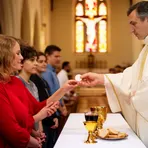
A Christian ceremony where people eat bread and drink wine to remember Jesus' death and his rising from the dead
Surface Forms
Morphology
The phrase is directly compositional: 'Eucharistic' (connected to the Eucharist) modifies 'liturgy' (a worship ceremony), so the combined meaning — the liturgical ceremony of the Eucharist — is transparently derivable from the parts. Although the terms are specialized religious vocabulary, the logic is straightforward and similar constructions exist across many languages, so a learner who knows both constituents can infer the MWE's meaning.
Etymology
Eucharistic liturgy comes from old Greek words: Eucharistic from a word meaning 'thanksgiving' and liturgy from a word meaning 'work for the people'. It paints the picture of a shared, thankful service where blessed bread and wine are given and eaten, so it now means the Christian ceremony that remembers the Last Supper.