

Eocene


 1
9.9
1
9.9
- noun
- /ˈiːoʊsiːn/
- Specialized
- Fossils from the Eocene provide vital insights into how species adapted to changing environments millions of years ago.
- Eocene cetaceans
Examples
-
The Eocene epoch is known for the emergence of many modern mammal families and significant climate changes.
-
During the Eocene, large mammals began to evolve, marking an important era in the history of life on Earth.
-
The event they might be referring to is the Eocene thermal maximum.
Blog text (14) -
So now in the Eocene and continuing the Ligocene a little bit, the world was pretty hot.
-
The diversity of Eocene cetaceans can be summarized into six families that together document the transition from land to water.
Academic text (2001) -
Flannery titled the section of the book that deals with the "verdant and productive" Eocene as: "In Which America Becomes a Tropical Paradise."
Blog text (33) -
The position of the orbits (eye sockets) also varies greatly among Eocene cetaceans.
Academic text (2001) -
The earliest cassids are known from the late Eocene in the Caribbean region, and the first urchin to show evidence of cassid predation is a fossil of this age from Cuba.
Academic text (1992)
Synonyms
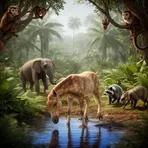
A period in Earth's history about 56 to 34 million years ago when many modern mammals appear
Compounds
- Specialized
A period in Earth's history about 56 to 34 million years ago when many modern mammals appear
Surface Forms
Morphology
Eocene = eo + cene
The name is built from Greek combining forms (eo- 'dawn' + -cene 'new') that are technical and not productive standalone English words, so an average learner cannot derive the meaning from the parts.
Etymology
Eocene comes from Greek roots Eo- meaning 'dawn' and -cene from kainos meaning 'new'. So, Eocene is like the 'dawn of the new' — the time when many modern mammals first appeared.