
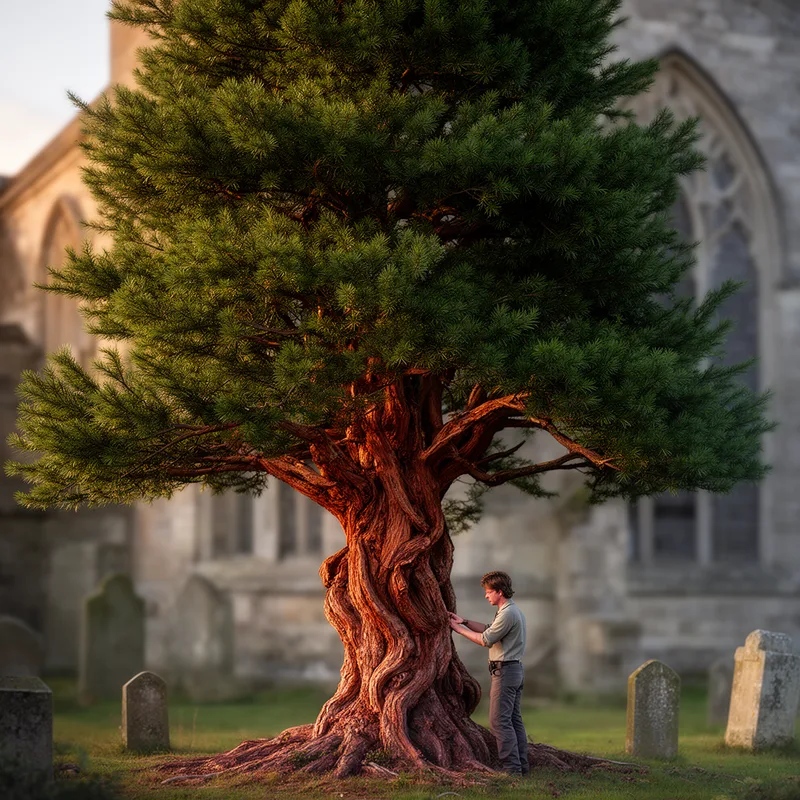
English yew
- noun
- The ancient English yew in the churchyard is believed to be over a thousand years old.
Examples
-
Many traditional longbows were crafted from English yew wood due to its strength and flexibility.
-
Botanists study the English yew for its remarkable resistance to disease and pests.
-
The English yew is a beautiful tree.
-
Many English yews grow in the churchyard.
-
The ancient English yew in the churchyard is believed to be over a thousand years old.
-
Many traditional longbows were crafted from English yew wood due to its strength and flexibility.
-
Botanists study the English yew for its remarkable resistance to disease and pests.
Synonyms

 5
6.7
5
6.7

An evergreen tree with flat needle-like leaves and red berries often used for hedges
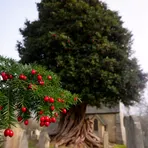
A long-lived evergreen tree from Europe and western Asia with dark green leaves and red poisonous berries

A slow-growing evergreen tree from Europe and parts of Asia that can live for many centuries
How Long-Lived

Surface Forms
Morphology
The meaning of 'English yew' is directly compositional: the adjective 'English' specifies the origin/type of the noun 'yew', so a learner who knows both words will infer it denotes a yew associated with England (a particular species or variety). This follows a common adjective + noun pattern found across languages, making the phrase immediately understandable to B1 learners.
Etymology
English yew comes from the strong yew trees that grew in English forests and were long used to make 'longbows'. Because these trees live a very long time and often stand by churches, the name now means this particular long-lived tree species.