

English ivy


 1
3.9
1
3.9
- noun
- /ˈɪŋɡlɪʃ ˈaɪvi/
- Her house was stucco and brick, somewhat shabbily overgrown with wisteria and English ivy.
Examples
-
During the autumn months, the English ivy's leaves turn a vibrant shade of yellow.
-
Hoot's house on Mercedes was still covered with English ivy, and the lawn still looked like a putting green, even though the grass hadn't been cut in a month or so.
Fiction book (1994) -
English ivy graced it in places.
Fiction book (1994) -
Except for that and the English ivy, trimmed to the edges of Hoot's sleeping porch out front, everything still looks pretty much the same.
Fiction book (1994) -
The English ivy climbs up the old brick wall, creating a lush green backdrop.
-
In many gardens, English ivy is often used as a ground cover due to its hardy nature.
Synonyms
 43
1.0
43
1.0
A climbing plant with green leaves and small dark berries that grows on walls

A climbing evergreen plant with shiny dark green leaves that often covers walls and ground
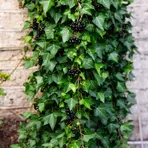
A climbing evergreen plant with lobed leaves and small black berries
Surface Forms
Morphology
The noun phrase is directly compositional: 'English' marks geographic/national association and 'ivy' names the plant, so a learner who knows both words will infer it is a kind of ivy associated with England. This nationality+noun naming pattern is cross-linguistically common, making the overall meaning transparent even if detailed botanical attributes require further knowledge.
Etymology
English ivy may come from the plant being very common on old English stone walls and houses; the part English points to 'from England' and ivy is the climbing plant, so the name means a vine that climbs and covers walls and buildings.