
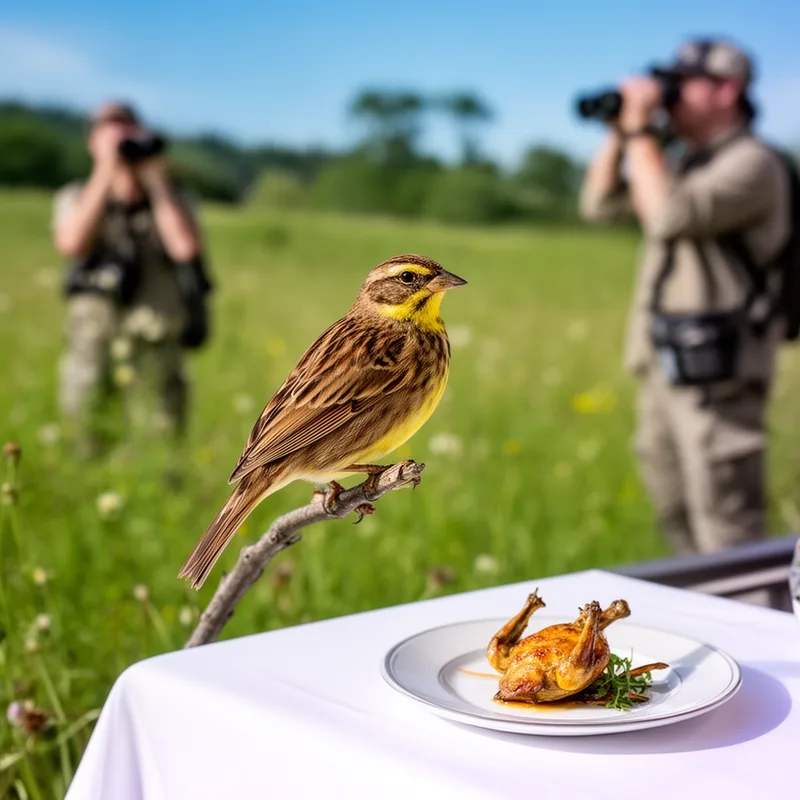
Emberiza hortulana
- noun
- Specialized
- Birdwatchers were delighted to spot a Emberiza hortulana in the meadow during migration season.
Examples
-
The Emberiza hortulana is protected by law in several countries due to declining populations.
-
Gourmets have historically regarded the Emberiza hortulana as a rare delicacy.
-
The Emberiza hortulana is a rare bird in Europe.
-
Did you know that the Emberiza hortulana is often considered a delicacy?
-
Many chefs consider the Emberiza hortulana a gourmet delicacy for its unique flavor.
-
The Emberiza hortulana is often celebrated in culinary traditions across various regions.
-
During a recent bird survey, we identified the Emberiza hortulana among the diverse species nesting near the lake.
Synonyms
 1
9.9
1
9.9

A small brown bird often eaten as a special food in France

A small brown songbird from Europe and western Asia sometimes eaten as a special food
Surface Forms
Morphology
Emberiza + hortulana
This is a Latin binomial proper name rather than a compositional English phrase; 'Emberiza' is a genus label and 'hortulana' is not a common English word (no dictionary definition given), so a B1 learner knowing the listed constituents would not be able to derive the meaning 'ortolan, a type of bunting'. Species names function as arbitrary labels and are not transparently built from everyday English vocabulary.
Etymology
Emberiza hortulana comes from older words: Emberiza was a name for small buntings and hortulana comes from Latin meaning 'garden', because people often saw the bird in fields and gardens. So the name paints the picture of a small, brown 'garden' bunting — the 'ortolan' — which explains why this name refers to that little bird.