
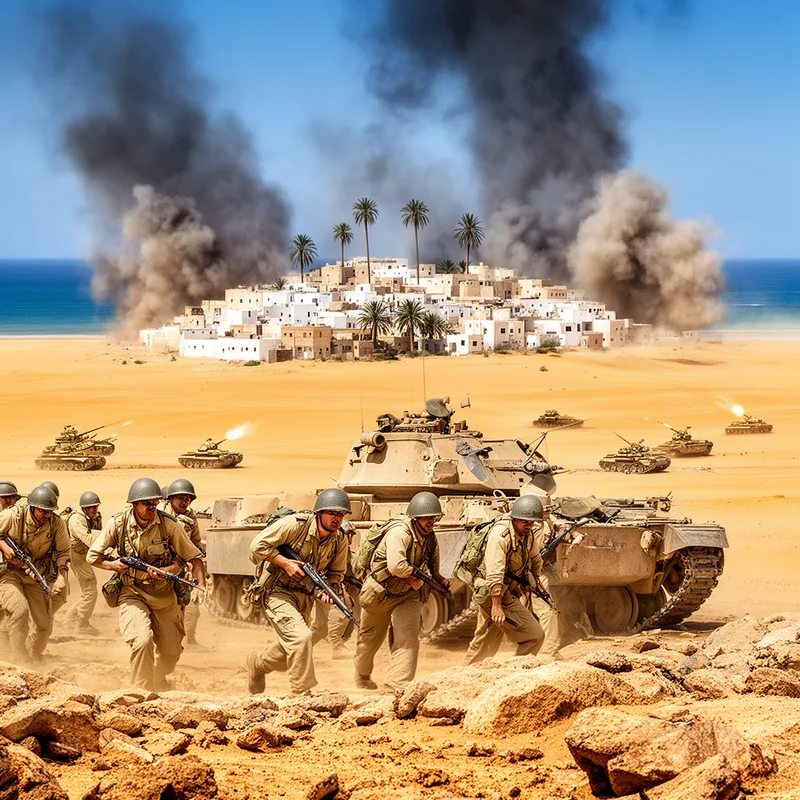
El Alamein
 1
7.9

- proper noun
- The town of El Alamein is known for its historical significance during the battles between Allied and Axis forces.
Examples
-
Germany throughout the war struggled for oil, and Rommel's Afrika Korps was itself nearly depleted at the time of El Alamein.
Blog text (9) -
My dad used bayonets at El Alamein (or maybe somewhere in Crete).
Blog text (9) -
Its latest success was commemorating the 70th anniversary of the decisive Battle of El Alamein at Westminster Abbey a couple of weeks ago.
Blog text (9) -
El Alamein was a tonic for somber Britain, which had weathered three years of nearly continuous defeat.
Blog text (9) -
Montgomery's 84-year-old son, the current Viscount of El Alamein, wonderfully read from St. Paul's Letter to the Romans at the commemorative service: "Let us then lay aside the works of darkness and put on the armor of light."
Blog text (9) -
The decisive Battle of El Alamein in 1942 marked a turning point in World War II.
-
In November 1942, the Allies celebrated their victory at El Alamein as a moment of hope.
Surface Forms
Morphology
El + Alamein
This is a proper name for a town and battle site; the constituent parts ('El' and 'Alamein') do not transparently convey the meaning 'town in northern Egypt' or the historical WWII significance, and the provided dictionary entries are absent. Place names are largely arbitrary or language-specific and must be learned as lexical wholes, so a B1 learner knowing the parts would not be able to infer the MWE's meaning.
Etymology
El Alamein comes from Arabic words meaning 'the two flags' or 'the two signs', a simple image of two sides facing each other. Because two huge battles were fought there in the desert in 1942, the name now makes people think of those battles and an important change in the war.